


Hairless Dog Breeds You’ll Love
 Dog Breeds
Written by
Kosar Koohi Updated 4 May 2026 · 11 Min Read
Kosar is the editor of Pretty Fluffy, a lifelong dog lover, and the proud mom of Yuki, a Maltese who has very high standards. So does Kosar. She researches everything obsessively before it ever makes it onto the page.
Hairless dog breeds are among the most ancient, most misunderstood, and most striking dogs in the world. They require less brushing than most dogs but more attention to their skin. They're often assumed to be hypoallergenic, which isn't quite accurate. And several of the breeds on this list are so rare outside their home country that tracking down an ethical breeder is a genuine challenge. This guide covers all ten hairless dog breeds: the four officially recognized breeds, plus the rare regional types that complete the picture. For each breed we've included quick facts, personality notes, a best-fit guide, and availability information where relevant.
Are Hairless Dogs Hypoallergenic?
This is the question most people arrive with, so let's address it directly: no dog is truly hypoallergenic, including hairless ones. People with dog allergies react primarily to a protein called Can f 1, found in dog saliva, urine, and dander — not fur itself. Research published in the American Journal of Rhinology and Allergy found no significant difference in allergen levels between so-called hypoallergenic breeds and non-hypoallergenic ones.
Hairless dogs produce all the same allergens, just like any other dog. That said, many allergy sufferers do find hairless breeds easier to tolerate. Less fur means less surface area for dander to cling to and less shed around the home. But the degree of relief varies enormously from person to person. If you're considering a hairless dog for allergy reasons, spend time with the specific breed before committing, ideally more than once, to see how your body responds.
Recognized vs. Rare Hairless Breeds: What's the Difference?
There's an important distinction worth making before we dive into the profiles. Four hairless breeds are internationally recognized: the Xoloitzcuintli, Chinese Crested, American Hairless Terrier, and Peruvian Inca Orchid. These have established breed standards, active breeder communities, and relatively accessible acquisition paths. The remaining breeds on this list are rare regional types. Some are not registered with any major kennel club. Some are near-impossible to find outside their country of origin. This matters if you're actually considering ownership rather than just enjoying the rabbit hole. We've flagged availability clearly for each.
Hairless Dogs: Breeds & Facts
1. Xoloitzcuintli (Mexican Hairless Dog)

The Xoloitzcuintli (pronounced "show-low-eats-QUEENT-lee") is one of the world's oldest dog breeds, dating back over 3,000 years to the ancient Aztec civilisation. Named after the Aztec god Xolotl and the word for dog, itzcuintli, the Xolo is Mexico's national dog and a genuinely ancient companion animal. They come in three sizes and two coat varieties: hairless and coated, with the coated version having short, sleek fur. In terms of temperament, Xolos have the calm alertness of a working dog. They're deeply loyal and affectionate with family, reserved with strangers, and surprisingly quiet for a watchdog. Early socialization is important — without it they can become overly wary of new people. They're intelligent, trainable, and relatively low-drama once settled.
- Lifespan: 13–18 years
- Good for: Active households wanting an unusual, deeply loyal companion with ancient pedigree
- Grooming needs: Low on brushing, but requires regular skin moisturizing and sunscreen in warm weather
Not ideal for:
Families with very young children who haven't had dogs before, or owners who want an immediately sociable dog with strangers.
Availability:
Moderate. The Xolo is not a common breed, but reputable breeders exist in the US, Mexico, and Europe. Expect a waiting list.
2. Chinese Crested

Despite the name, the Chinese Crested likely didn't originate in China. Research suggests the breed may share genetic roots with the Xolo and developed in the Americas, before Chinese sailors traded them across continents. The name stuck regardless. The Chinese Crested comes in two varieties: the Hairless, which has tufts of silky hair on the head, paws, and tail tip, and the Powderpuff, which has a full soft coat. Both can be born in the same litter. In temperament, the Chinese Crested is one of the most affectionate dogs on this list: social, playful, and deeply attached to their person. Some owners describe them as almost cat-like in the way they perch and observe.
- Lifespan: 13–18 years
- Good for: Singles, couples, families, seniors — genuinely one of the most versatile small dogs around, including apartment living
- Grooming needs: The hairless variety needs skin care and occasional moisturizing; the Powderpuff variety requires regular brushing
Not ideal for:
Anyone wanting a naturally independent dog, or an outdoorsy companion for long hikes.
Availability:
Common. The Chinese Crested is the most widely available hairless breed and one of the most popular in the world.
3. American Hairless Terrier

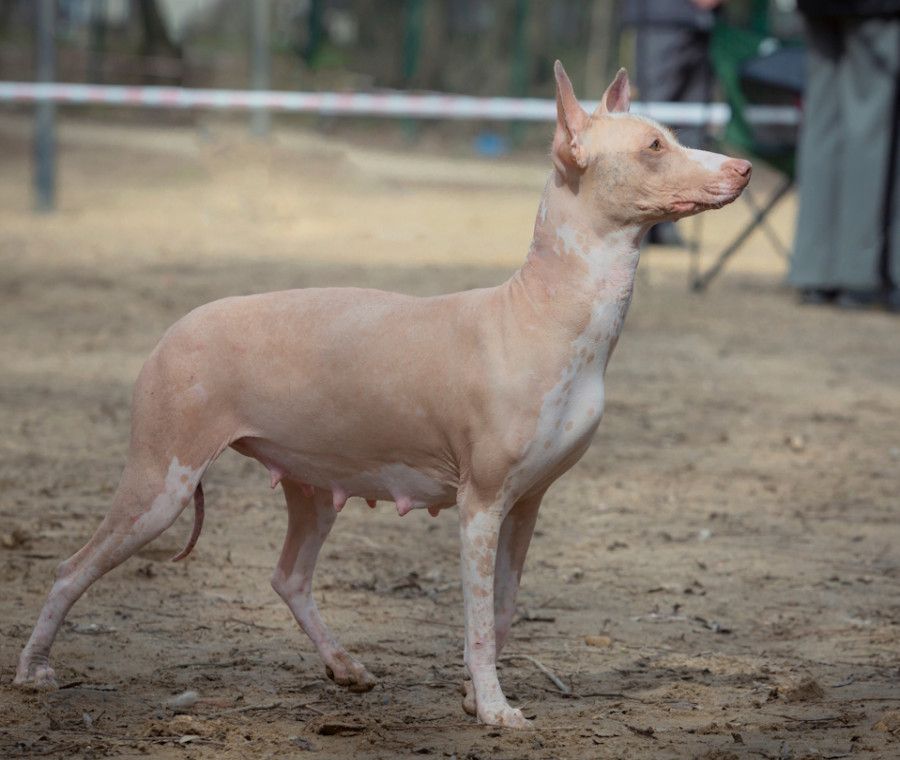
The American Hairless Terrier is the only hairless breed native to the United States, and one of the most recently officially recognized hairless breeds. The breed traces back to 1972, when a hairless pup was born into a litter of Rat Terriers in Louisiana. The Scott family recognized the uniqueness and developed the line from there, with formal breed recognition following in 2016. Unlike other hairless breeds, the AHT carries its hairlessness from a different gene (SGK3) rather than the FOXI3 gene found in Xolos, Cresteds, and PIOs. This means they're born with a light fuzz that disappears in the first few weeks of life, leaving completely smooth skin. No tufts, no patches. They have pricked ears, expressive eyes, and may have eyebrows and whiskers. Personality-wise, they're classic terriers: high-energy, curious, intelligent, and alert. They make excellent watchdogs and are surprisingly good with children given their size and enthusiasm.
- Lifespan: 14–16 years
- Good for: Active families and first-time owners who want a spirited, trainable dog without heavy grooming demands
- Grooming needs: No brushing required, but skin needs regular cleaning and sunscreen before outdoor time
Not ideal for:
Low-energy households or anyone without time for regular exercise and mental stimulation.
Availability:
Common. Breeders are well-established across the US.
4. Peruvian Inca Orchid

The Peruvian Inca Orchid (PIO) is Peru's national dog, with pre-Inca origins dating back over 3,000 years. Spanish conquistadors reportedly discovered these elegant hairless dogs living inside Inca homes in the 1500s among orchid flowers, giving them their poetic name. They come in three sizes and are one of the most striking hairless breeds visually. The PIO has a high prey drive and a naturally sensitive, somewhat independent temperament. They're deeply loyal to their family but can be wary of strangers and reactive without thorough early socialization. This is a breed that rewards experienced, patient owners who understand and respect their instincts.
- Lifespan: 12–14 years
- Good for: Experienced dog owners who appreciate a spirited, independent companion with ancient heritage
- Grooming needs: Minimal brushing, but skin care is essential — regular moisturizing and sun protection required
Not ideal for:
First-time owners, households with cats or small animals, or families with young children who haven't researched the breed carefully.
Availability:
Moderate. More common in South America; US and European breeders exist but are fewer.
5. Hairless Chihuahua

The Hairless Chihuahua isn't a separate breed but a genetic variant of the standard Chihuahua, resulting from a naturally occurring mutation that causes hairlessness. Everything else about the dog is the same: the same bold personality, the same loyalty to one person, the same suspicion of strangers that belies their tiny frame. Because the hairlessness is a spontaneous variation rather than purposeful breeding, Hairless Chihuahuas are uncommon and not consistently available from breeders. Unethical sourcing is a real concern in this space, so due diligence matters.
- Lifespan: 14–16 years
- Good for: Experienced small-dog owners who understand Chihuahua temperament and want a truly unique variation
- Grooming needs: No brushing, but skin is especially delicate — sunscreen and moisturizing are a must
Not ideal for:
Households with young children or large dogs. Hairless Chihuahuas are fragile and temperamentally particular.
Availability:
Rare. Not intentionally bred as a standard, so finding one requires patience and care in sourcing.
Rare Hairless Breeds of Dogs
The following breeds are not registered with major kennel clubs. They exist primarily in their country of origin, with very limited presence elsewhere. If you're researching these out of curiosity, they're fascinating. If you're considering ownership, be aware that finding one ethically outside their home country is extremely difficult.

6. Argentine Pila Dog

The Argentine Pila shares a close genetic heritage with the Peruvian Inca Orchid and was likely brought to Argentina from Peru by pre-Columbian traders. They come in three sizes, have smooth warm skin, and are known for being affectionate, playful family dogs who adapt well to different living situations.
- Lifespan: 12–15 years
- Good for: Families looking for an affectionate, adaptable companion
- Grooming needs: Low maintenance, but routine skin care and sun protection apply
Availability: Very rare outside Argentina. No established breeder network internationally and not registered with major kennel clubs.
7. Hairless Khala

The Argentine Pila shares a close genetic heritage with the Peruvian Inca Orchid and was likely brought to Argentina from Peru by pre-Columbian traders. They come in three sizes, have smooth warm skin, and are known for being affectionate, playful family dogs who adapt well to different living situations.
- Lifespan: 12–15 years
- Good for: Families looking for an affectionate, adaptable companion
- Grooming needs: Low maintenance, but routine skin care and sun protection apply
Availability: Very rare outside Argentina. No established breeder network internationally and not registered with major kennel clubs.
8. Ecuadorian Hairless Dog
The Ecuadorian Hairless is a very rare and little-documented hairless dog type native to Ecuador. Archaeological evidence suggests dogs of this type existed in the region thousands of years ago. They are considered a regional variety rather than an established breed, with no formal breed standards or international registry.
- Lifespan: Unknown
- Good for: Regional ownership in Ecuador
- Grooming needs: Presumed similar to other hairless types — skin care and sun protection likely required
Availability: Extremely rare. Essentially unknown outside Ecuador and not available through any international breeder network.
9. Jonangi

The Jonangi is an ancient Indian breed, historically used as a herding and hunting dog along the east coast of India. They are lean and athletic, with smooth tight skin and pricked ears. Unusually for a dog, Jonangi dogs tend to yodel or chortle rather than bark, which makes them surprisingly quiet companions. They're energetic and intelligent, and have an independent streak that comes from their working origins.
- Lifespan: 10–14 years
- Good for: Active owners in India who appreciate a working-dog temperament
- Grooming needs: Very low — smooth skin requires only basic cleaning and occasional sun protection
Availability: Very rare outside India. Interest has grown within India in preserving the breed, but international availability is extremely limited.
10. Abyssinian Sand Terrier
Also known as the African Hairless Dog or Egyptian Hairless Dog, the Abyssinian Sand Terrier is one of the rarest dogs in the world. It is believed to be among the oldest of all hairless breeds, with origins in Africa that may predate other hairless dog lineages. They are lean, elegant, and calm-natured, but so rare that very little is reliably documented about their modern temperament and health.
- Lifespan: 12–15 years (estimated)
- Good for: Breed historians and conservationists with a deep interest in indigenous dog preservation
- Grooming needs: Presumed minimal — bare skin would require standard hairless dog care
Availability: Extremely rare globally. May be critically endangered as a distinct type.
Hairless Dog Care: What You Need to Know
Skin Care Routine
Hairless dogs don't need brushing, but they do need regular skin attention. Without a coat, their skin is directly exposed to sun, cold, dirt, and friction. Here's what a proper routine looks like: Weekly:
- Gentle bath with a mild, dog-safe cleanser. Don't over-bathe — it strips natural oils.
- Check for blackheads, acne, or irritation, particularly on the back and neck where skin folds can trap dirt.
- Moisturize if the skin looks or feels dry. Use a pet-safe fragrance-free lotion, not human products.
Daily:
- Quick skin inspection for redness, rashes, or scratches.
- Apply pet-safe sunscreen to any exposed skin before outdoor time in sunny weather. Yes, hairless dogs can sunburn.
Seasonal:
- In winter, most hairless dogs need a jumper or coat for walks. Their skin offers no insulation.
- In summer, shade access is essential. Avoid midday walks on hot pavement.
For more on enrichment and day-to-day care, browse our Pretty Fluffy Directory.
Dental Care
Some hairless breeds, particularly the Xolo and Chinese Crested, may have missing or unusually shaped teeth as a side effect of the hairless gene. Regular dental checks with your vet are important, and home brushing where possible helps maintain what's there.
Cold and Sun Sensitivity
This is the trade-off that comes with the territory. Hairless dogs need protection from both extremes. A well-fitted harness and a warm coat for winter walks, and pet-safe sunscreen for summer outings, are genuinely non-optional for these breeds.
Which Hairless Dog Breed Is Right for You?
Best for families:
Chinese Crested. Adaptable, affectionate, gentle, and endlessly sociable.
Best for active households:
American Hairless Terrier. High energy, playful, and a genuinely fun dog to train and live with.
Best watchdog:
Xoloitzcuintli. Calm, alert, deeply loyal, and naturally protective of their people.
Best for experienced owners:
Peruvian Inca Orchid. Spirited, independent, and magnificent in the right hands.
Rarest and most historically significant:
Abyssinian Sand Terrier and Hairless Khala — fascinating breeds that very few people outside their home regions will ever encounter. If you're seriously considering a hairless dog, take the time to meet the breed in person, research ethical breeders carefully, factor in the ongoing skin care costs, and if possible, speak with current owners. These breeds are genuinely special, but they do require specific commitment.
FAQ
Frequently asked questions
01 Are hairless dogs really hypoallergenic?
No. People with dog allergies react to proteins in dander, saliva, and urine — not fur. Hairless dogs produce all of these. However, many allergy sufferers find hairless breeds easier to tolerate because there's less fur trapping and spreading dander around the home. The only reliable way to know if you'll react is to spend time with the specific breed before committing.
02 Do hairless dogs get cold easily?
Yes. Without a coat, hairless dogs have no natural insulation. Most need a jumper or coat for walks in cool or cold weather, and shouldn't be left in low temperatures without warmth. This is one of the practical realities of hairless dog ownership that is easy to underestimate.
03 Do hairless dogs need sunscreen?
Yes. Bare skin is vulnerable to UV damage just like human skin. A pet-safe sunscreen should be applied to exposed areas before extended outdoor time in sunny weather. Some hairless dogs can develop sunburn in as little as 30 minutes of midday exposure, and repeated sun damage can increase skin cancer risk.
04 What is the most popular hairless dog breed?
The Chinese Crested is the most widely owned and most commonly available hairless dog globally. The Xoloitzcuintli and American Hairless Terrier are also growing significantly in popularity, particularly in the US.
05 Can hairless dogs be left alone?
This varies by breed. The Chinese Crested and Xolo, for example, form strong bonds with their owners and can be prone to separation anxiety if left alone frequently. All dogs benefit from routine, company, and enrichment. For boredom-busting tips when you do need to leave them, see our enrichment guide.
06 Which hairless dog is best for first-time owners?
The American Hairless Terrier and Chinese Crested are both considered beginner-friendly. They're trainable, sociable, and don't have the strong prey drive or wariness of the Xolo and PIO that can make those breeds more demanding for inexperienced owners.
Related Reading


Join the Conversation Be the first to comment