


5 Dog Food Storage Cabinets With Bowls
 Editor's Picks
A twenty-pound bag of kibble has nowhere good to live. It slouches in the pantry, tips over in the laundry room, and sheds crumbs across the floor every time the scoop goes in. Meanwhile the bowls sit in the middle of the walkway, getting kicked twice a day.
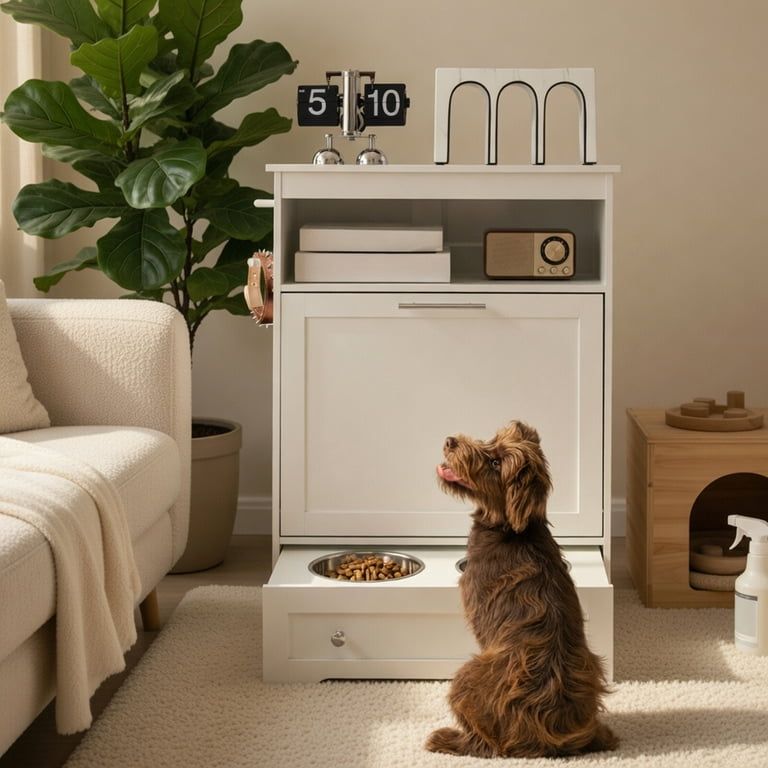
A dog food storage cabinet puts an end to both problems with one piece of furniture: the bag goes behind a door, and the bowls get a permanent home at a set height. The five picks below are grouped by how they handle the bowls, from raised bowls on top to a dog drawer that slides away between meals, with notes on who each one suits and what to check first.
RELATED: A Day in the Life of a Dog Mom
How to Choose a Dog Feeding Station With Food Storage
A feeding cabinet is a piece of furniture that keeps the food bag behind a door and holds one or two bowls at a fixed height, either on the top surface or in a pull-out drawer. The right one matches bowl height to the dog standing in front of it, swallows the size bag that actually gets bought, and latches firmly enough that a determined nose cannot nudge it open. Small and medium dogs usually suit a cabinet with built-in bowls, while large and giant breeds are safest eating at floor level.
Beyond that, most of the decision is about where the cabinet will stand. A unit in a kitchen galley needs bowls that get out of the way, a unit in a mudroom can leave them out, and anything near a doorway needs to take a shoulder from a dog in a hurry. For bowls bought separately, the dog bowls and feeding directory is a good place to compare shapes and materials.
Bowl Height and Bloat Risk for Large Breeds
Raised bowls are usually sold as the kinder option, and for a small dog or an arthritic senior, a bowl that saves a deep stoop genuinely helps. The evidence for big dogs points the other way. In a study that followed 1,637 dogs across eleven large and giant breeds, those fed from a raised bowl were around twice as likely to develop gastric dilatation volvulus, the twisting of the stomach commonly called bloat, and the researchers attributed roughly 4 percent of cases in large breeds and 8 percent in giant breeds to raised feeding.
A later survey found no such link, so this is an association rather than a settled rule. Still, since nothing suggests raised bowls reduce the risk, the cautious choice for a Great Dane, a Weimaraner, a Standard Poodle or any deep-chested breed is to feed on the floor and use the cabinet purely for storage. For everyone else, aim for a bowl rim somewhere near the dog's lower chest, so the neck stays level rather than reaching up or craning down.
Bag Capacity and Keeping Kibble Fresh
Cabinets rarely publish a kibble capacity the way plastic bins do, so measure the bag currently in the pantry and check it against the internal shelf space before ordering. The more useful habit is to keep the food in its own bag, rolled down and clipped, and stand the bag inside the cabinet rather than tipping loose kibble into a bare compartment. The bag's liner is built to hold fats in and air out, and it carries the lot number and best-before date if a recall ever matters.
Dry food also keeps best somewhere cool and dry, under about 80 degrees, which rules out a sunny patio or a spot beside the oven. That matters more with a richer recipe, since higher-fat formulas go stale faster, and the guide to choosing a dry dog food is worth a look when the bag is nearly empty.
Dog Proof Latches and Tip Over Safety
Almost every listing in this category claims to be dog proof, and almost none of them explain what that means. In practice it comes down to how the doors are held shut. Magnetic catches stop a casual nose but rarely stop a Labrador with a plan, so a dog food storage cabinet within reach of a food-motivated dog does better with a childproof latch added to the inside, the same trick that works on kitchen cupboards in these puppy-proofing tips.
Stability is the other check. Flat-pack cabinets in this price range are mostly particle board, which is light enough to rock when a big dog leans in to eat. Anchor anything tall to the wall, keep the heaviest bag on the bottom shelf, and tighten the cam fittings again a week after assembly, once the panels have settled.
Dog Feeding Cabinet Comparison Chart
| Cabinet | Bowl setup | Best for | Where it suits |
|---|---|---|---|
| Rovibek Storage Cabinet | Two raised bowls | Small to medium dogs | Kitchen or mudroom corner |
| FIMELLO Feeder Station | Raised bowls plus cabinet | One dog, open-plan rooms | Living space, left on show |
| Pefilos Pull Out Cabinet | Dog drawer, two bowls | Tight walkways | Galley kitchen or hallway |
| Furnivio Tilt Out Cabinet | One bowl, two bins | Doing two jobs at once | Small kitchen, bin side |
| Furnaza Dual Door Cabinet | Storage led, bowls on top | Big bags and multi-dog homes | Pantry, laundry or garage |
Raised Dog Bowl Cabinets for Everyday Feeding
These two keep the bowls out and ready, which suits a settled feeding spot where nobody is stepping over them.
1
Rovibek Dog Food Storage Cabinet with 2 Raised Dog Bowls

Price last checked October 2026 · may vary
The straightforward version of the idea, and the least expensive pick here. Two raised bowls sit ready at the front while the food and the scoop live behind the door, so one piece of furniture handles the whole feeding corner. Two bowls also means food and water in the same place, which saves the water bowl from its usual career of being kicked across the floor.
Because the bowl height is built in rather than adjustable, this is a cabinet to measure for. Hold a tape measure to the dog's lower chest first. It suits small and medium dogs comfortably, and deep-chested giants are better off eating on the floor regardless of what the cabinet can hold.
2
FIMELLO Dog Feeder Station and Pet Storage Cabinet

Price last checked October 2026 · may vary
A feeding station first and a storage cabinet second, built to be looked at rather than hidden in a utility room. That makes it the easiest of these five to place in an open-plan space. Furniture that earns a place in a living room is the same logic behind the better dog beds for every sleeper.
Check the finish against the floor and the nearest cabinetry before ordering, since a warm oak tone and a cool floor can fight each other. Wipe the top down daily, because an open station collects splashes a closed drawer would have caught.
Dog Drawer and Tilt Out Cabinets for Small Kitchens
When the feeding spot doubles as a walkway, bowls that disappear between meals are worth more than bowls that look pretty.

What Counts as a Dog Drawer
A dog drawer is any bowl setup that slides out of sight, and it comes in two forms. The first is a pull-out tray built into a feeding cabinet, which arrives flat-packed, needs no fitting and can move house. The second is a toe-kick drawer, joinery built into the base of existing kitchen cabinetry so the bowls tuck away under the counter and take up no floor space at all.
Toe-kick drawers look better and cost several times as much, since they are made to measure and stay with the house. For most homes a drawer cabinet gets the same clear floor for a fraction of the price, and it can be moved when the kitchen layout changes.
3
Pefilos Pull Out Pet Food Cabinet with 2 Raised Dog Bowls

Price last checked October 2026 · may vary
The clever one, and the closest thing here to a built-in dog drawer. Two removable stainless steel bowls sit in a tray that slides out for dinner and pushes back in afterward, so the floor is clear the other twenty-three hours of the day. Stainless is also the easiest bowl material to keep properly clean, since it will not scratch into the fine grooves that plastic develops and bacteria settle into.
Cabinets in this line usually carry hooks on the side for a leash and a harness, and they are particle board, so the wall-anchor advice applies. A sliding drawer suits a dog who waits for food to be served rather than one who grazes, and it is the pick for anyone whose dog eats in a doorway.
4
Furnivio Double Tilt Out Trash Can Cabinet with Dog Bowl

Price last checked October 2026 · may vary
Two hidden bins behind tilt-out doors, plus a dog bowl built into the same unit. In a small kitchen that is a genuinely good trade, because it covers the trash, the recycling and the dog in the footprint of one cabinet, and tilt-out doors are harder for a dog to open than a swinging lid.
The honest caveat is hygiene. A bowl that lives next to the garbage needs lined bins, a lid on each one, and a wipe-down of the top every time the trash goes out. It is also the only pick here buying two pieces of furniture at once, and a latch is sensible for any dog who counter-surfs for scraps.
Large Dog Food Cabinets With Double Door Storage
For households buying the big bag, or feeding more than one dog, storage volume matters more than a clever drawer.
5
Furnaza Dual Doors Dog Cabinet Storage

Price last checked October 2026 · may vary
Two doors opening onto one storage space, which is the configuration to want when the shopping involves the large bag. Twin doors give a wider opening than a single hinged door, so a heavy bag goes in and out without being wrestled through a gap, and there is room left for the treat jar and the towels.
It is the most storage-led pick of the five, so plan where the bowls go. In a multi-dog home that is often the right split anyway, with bowls spaced apart on the floor to keep mealtimes calm and the cabinet handling everything else. Anchor it to the wall once the bag is in.
Setting Up the Feeding Area Around the Cabinet
The cabinet solves storage. The square meter around it is what decides whether mealtimes stay tidy.
Mats, Water Bowls and Floor Protection
A washable silicone or rubber mat under the bowls catches the splashes and the dropped kibble, and it stops a metal bowl from skating across tile while a dog chases the last piece. Keep the water bowl a step away from the food, since enthusiastic eaters are the same dogs who tip water into their dinner. For the rest of the fallout, from flicked food to drool on the cabinet door, these pet cleaning tips for dog owners cover the cleanup properly.
Washing Bowls and Measuring Portions
Bowls want soap and hot water after every meal, not a rinse, and the same goes for the scoop. Never scoop with the bowl itself, and keep one dedicated cup or scoop in the cabinet so the kitchen measuring cups stay out of the kibble. Measure rather than estimate, too, because a generous eyeballed scoop twice a day is how a dog gains a pound a month without anyone noticing. Portion control is the whole foundation of the best dog food for weight loss picks, and it starts at the cabinet door.
What Else Belongs in a Pet Food Cabinet
The shelf space is worth planning. Leashes, poop bags, the towel for muddy paws, a spare collar and the treat jar all earn a spot, and so does a slow feeder or snuffle mat if dinner gets inhaled in forty seconds, which is one of the simplest boredom busters for dogs and puppies going.
Keep medications and supplements in a closed container rather than loose. A rotation of dog toys for chewers is also better off behind the doors than in the toy basket, since a toy that disappears for a week comes back interesting.
FAQ
Frequently asked questions
1Are elevated dog bowls better for dogs?
For small dogs, senior dogs and dogs with neck or joint pain, a raised bowl makes eating more comfortable. For large and giant breeds, research has linked raised bowls to a higher risk of bloat, so floor feeding is the safer default for deep-chested dogs. Ask a vet about a specific dog, especially after surgery or a bloat scare.
2How do you keep dog food fresh in a storage cabinet?
Keep the kibble in its original bag, roll the top down and clip it, then stand the bag inside the cabinet. The bag liner blocks air and holds the fats in better than a bare compartment does, and it keeps the lot number and date available. Store it somewhere cool and dry, below 80 degrees.
3Can a dog open a food storage cabinet?
A determined dog can open most magnetic catches with a nose or a paw, which is why so many listings promise a dog-proof design and so few deliver one. A dog drawer or a tilt-out front is harder to defeat than a hinged door. For a serious food thief, add a childproof latch inside the door.
4What height should a dog bowl be?
Aim for the bowl rim to sit roughly level with the dog's lower chest, so the neck stays straight rather than reaching up or craning down. Measure from the floor to the point of the chest and use that as a ceiling. Puppies grow into the measurement, so recheck it every couple of months.
5Where should a dog food cabinet go?
A dog food storage cabinet does best somewhere cool and dry, out of the main traffic path, with room for a dog to stand square at the bowls without being stepped over. Kitchens, mudrooms and laundries all work. Avoid direct sun, the space beside an oven, and a damp garage wall, since heat and humidity shorten a bag's life.
Choosing the Right Feeding Cabinet for Your Home
Start with the dog rather than the furniture. A small dog in a tight kitchen is best served by a dog drawer, a big dog by a storage-led cabinet and bowls on the floor, and a shared living space by a station that looks like furniture. After that it comes down to the bag in the pantry and the wall it will stand against.
For a closer look at the evidence on bowl height, this peer-reviewed knowledge summary weighs both studies on raised bowls and the risk of bloat and explains why floor feeding is still the cautious choice for at-risk breeds.
Related Reading


Share a thought, ask a question, or tell us about your own dog. We read every comment.