


Dumbest Dog Breeds We Absolutely Adore
 Opinion
You said sit. Your dog looked at you, looked at the treat, considered the whole proposition, and wandered off to smell the couch. If that is your evening, you have probably typed "dumbest dog breeds" into a search bar at some point, half worried and half amused, wondering whether your dog is on the list.
Here is the thing worth knowing before you scroll. That famous ranking measures one narrow skill, and it is not the one most of us mean by clever. It measures how quickly a dog learns a command from a human and how reliably they obey it. Plenty of dogs score badly on it while being sharp, funny, resourceful company, which is exactly why the breeds below are so loved. If you want the other end of the scale, we have ranked the smartest dog breeds too.
What Is the Dumbest Dog Breed?
The Afghan Hound is generally named the dumbest dog breed, based on psychologist Stanley Coren's ranking of working and obedience intelligence in The Intelligence of Dogs. Breeds in that bottom tier typically need 80 to 100 repetitions or more to learn a new command, and obey a known command on the first attempt around 25 percent of the time or less. For comparison, the Border Collie at the top of the same ranking learns in fewer than five repetitions and obeys first time 95 percent of the time.
Those figures come from surveys of obedience trial judges across the United States and Canada, not from a laboratory, and Coren has always been open that the ranking is about trainability rather than raw brainpower. He has written about the method and its limits himself in Psychology Today.
So an Afghan Hound taking a hundred goes to learn "come" is not evidence of an empty head. It is evidence that an Afghan Hound has thought about coming, weighed it up, and decided against. If you would like to see how your own dog measures up on a broader set of skills, our at-home dog IQ quiz tests memory, problem solving and social smarts rather than obedience alone.
Least Intelligent Dog Breeds, Ranked From the Bottom Up
These are the eleven breeds that sit in the lowest obedience tier of Coren's ranking, in order from the very bottom, plus one addition of our own at number twelve. Every one of them is somebody's beloved dog, and most of them are extremely good at a job that has nothing to do with sitting on command.
Obedience Rankings at a Glance
| Rank | Breed | Size | Why they score low | Best suited to |
|---|---|---|---|---|
| 1 | Afghan Hound | Large | Aloof and independent | Patient owners who enjoy a challenge |
| 2 | Basenji | Small | Cat-like, bores quickly | Experienced, active homes |
| 3 | Bulldog | Medium | Stubborn, low drive | Quiet homes and short walks |
| 4 | Chow Chow | Medium to large | Reserved, needs to trust you first | Confident, consistent owners |
| 5 | Borzoi | Large | Sensitive, dislikes repetition | Calm households with space |
| 6 | Bloodhound | Large | Ruled entirely by scent | Secure yards and long trails |
| 7 | Pekingese | Small | Self-possessed lap dog | Gentle, unhurried homes |
| 8 | Beagle | Small to medium | Nose beats every command | Fenced yards and food rewards |
| 9 | Mastiff | Giant | Slow, deliberate, bores fast | Space, strength and short sessions |
| 10 | Basset Hound | Medium | Laid-back and scent-driven | Relaxed homes, no jogging |
| 11 | Shih Tzu | Small | Bred purely for company | Companion-focused households |
| 12 | Chihuahua | Small | Usually undertrained, not untrainable | Owners who train them like real dogs |
1. Afghan Hound

Afghan Hounds move through the world like they are being paid by the photograph, and they know it. That famous silk coat comes attached to one of the most self-contained temperaments in dogs, bred for centuries to hunt across open country by sight, alone, making its own decisions at speed.
Which is precisely why obedience work bores them. An Afghan will learn what you are asking and then quietly decline. Recall is the real issue rather than intelligence, because a sighthound in pursuit is genuinely not listening to anything, so secure fencing is not optional. They suit an active owner who can give them a proper run and take the aloofness as character rather than rejection.
2. Basenji

The barkless dog of central Africa yodels instead of barking, grooms itself like a cat, and holds opinions about your training plan. Basenjis are curious and quick, and they will absolutely solve a problem that stands between them and something they want. They just see no reason to solve one you invented for them.
Training works in short, high-value bursts. Ask twice, reward well, stop before they get bored, because a bored Basenji simply leaves. Their story is much the same as the dachshund's low obedience ranking: an independent hunting breed measured on how well it takes instruction.
3. Bulldog

Ask a Bulldog to sit and there is a real chance they will lie down instead, having decided that sitting is an unnecessary halfway house. They are affectionate, funny, deeply attached to their people, and entirely unbothered by your schedule.
Low obedience scores here are about motivation rather than capacity. Bulldogs learn fine when the reward is worth getting off the rug for. Their modest exercise needs and calm indoor manner make them one of the best dogs for seniors, though the flat face means heat and hard exercise need managing carefully.
4. Chow Chow

With the blue-black tongue and the scowl of a small offended lion, the Chow Chow was bred to guard temples and homes, and the job description did not include eagerness to please. They are loyal to their own family and reserved with everyone else, and they will not perform for a stranger.
Respect has to be earned before training gets anywhere, which is why they land on lists like this one. Early socialization matters enormously with this breed. On the plus side, that self-sufficiency means they cope better alone than most, which is rare among the breeds prone to anxiety.
5. Borzoi

Bred by Russian nobility to course wolves, the Borzoi is fast, elegant and surprisingly sensitive. Sharp corrections shut them down completely, and long drilling sessions bore them into a sort of polite blankness that gets mistaken for stupidity.
Keep sessions to a few minutes, keep the mood light, and a Borzoi will surprise you. They are quiet, undemanding housemates who spend most of the day horizontal, then remember they can hit forty miles an hour and take the yard apart for ninety seconds.
6. Bloodhound

There is no arguing with a Bloodhound on a scent, and honestly there is no point trying. Their tracking is so reliable that it has been accepted in court, and while they are working, your voice is simply one more thing happening a long way away.
That single-mindedness costs them on every obedience list ever compiled, and it makes them world-class at the one thing they were built for. Away from a trail they are soft, patient and famously tolerant, which is why they appear so often among the best family dogs. Just never trust a Bloodhound off lead near an open gate.
7. Pekingese

Bred to sit in the sleeves of Chinese royalty, the Pekingese has never quite let the role go. They are brave, devoted and quietly certain that commands are for other dogs. Trainers regularly rank them among the hardest breeds to teach anything to, which given the competition on this list is quite the achievement.
They are also alert little watchdogs with real courage in a very small frame. Keep sessions short and dignified, because a Pekingese who feels made a fool of will remember it.
8. Beagle

Beagles are merry, sociable and completely governed by their nose. Training goes beautifully right up until a crumb, a fox or a neighbor's barbecue enters the picture, at which point you and your treat pouch cease to exist.
They are food-motivated enough to make real progress indoors, and they were bred to work in packs, so they are rarely aloof the way the sighthounds are. Give them scent games and puzzle work instead of drilling, since these ways to mentally stimulate your dog tire out a hound far more effectively than another lap of the park.
9. Mastiff

Everything a Mastiff does happens on a delay. Ask for a sit and you may get one several seconds later, delivered with the air of a dog who has considered the request properly rather than jumping at it. That unhurried processing reads as slow, and it is really just a very large dog conserving energy.
Short sessions work best, because they bore quickly and a bored Mastiff is a very heavy thing to motivate. Like the livestock guardian breeds, they were developed to work without supervision, which never scores well on a test built around taking orders.
10. Basset Hound

All the Bloodhound's scenting power in a shorter, more comfortable package, with a matching commitment to lying down. Bassets are cheerful and famously easygoing, and getting one motivated for a training session is a project in itself.
Housebreaking takes patience and recall takes a fenced yard, since a Basset on a scent will simply keep walking. Watch their weight too, because those short legs and long back do not forgive extra weight.
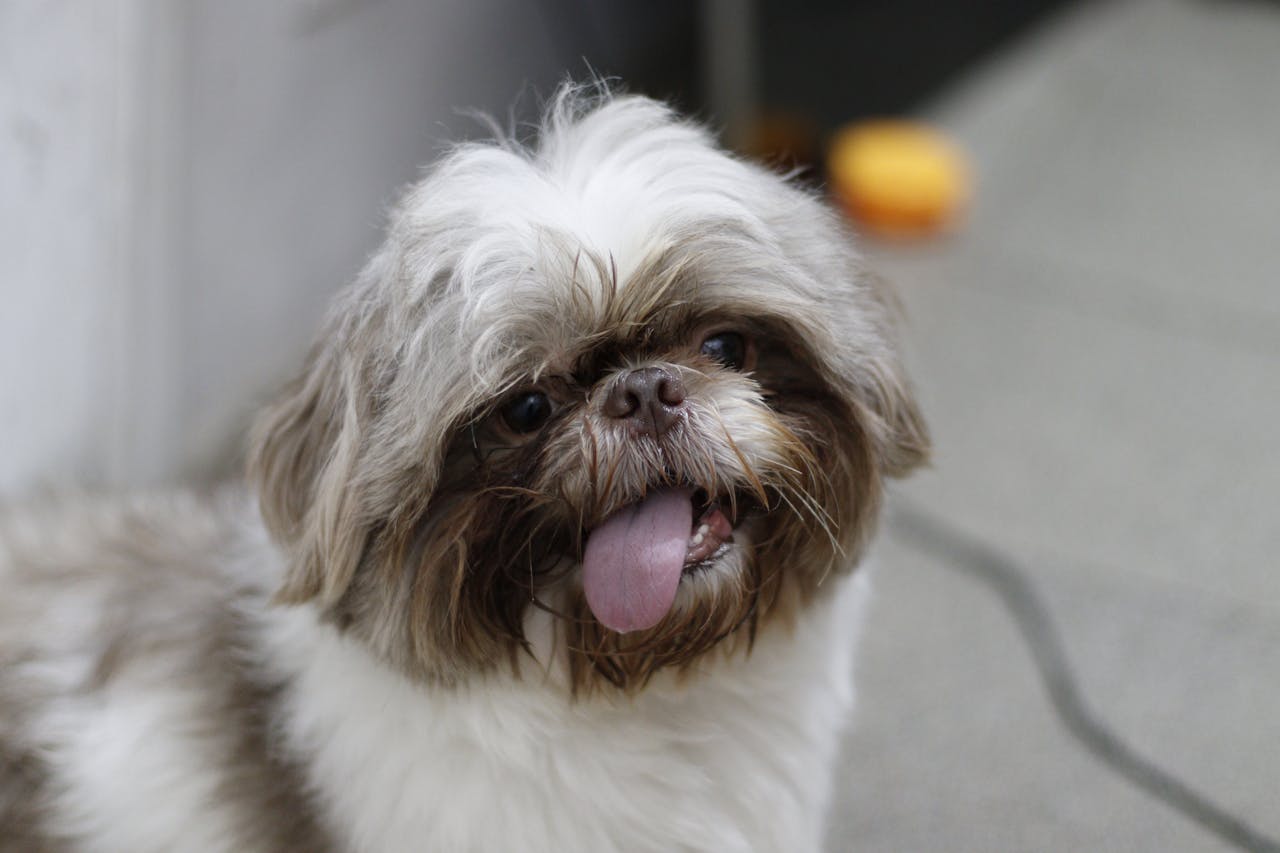
11. Shih Tzu

The Shih Tzu was bred for one job, which was being excellent company, and they have never needed another. There is no herding instinct here, no retrieving drive, no puzzle they feel obliged to solve. What there is instead is a small, cheerful dog who is very good at charming everyone in the room.
Housebreaking is the usual sticking point and can take months, particularly in wet weather, which a Shih Tzu regards as a personal insult. Grooming is the real commitment with this breed, not training.
12. Chihuahua

Worth being straight about this one. The Chihuahua does not appear in the lowest tier of Coren's ranking at all, and sits closer to the middle of it. We have included them because they turn up on almost every list like this, and because the reason is worth understanding.
Chihuahuas are frequently undertrained rather than untrainable. Because they are small, behavior that would never be tolerated in a Labrador gets laughed off, and a dog who has never been asked for anything grows into a dog who does not answer. Train one properly and you get a bright, quick, extremely loyal little dog. Skip it and you get the barking, and sometimes the snapping, which is worth reading about in our guide to why Chihuahuas can turn aggressive.
Do Low IQ Dog Breeds Really Exist?
Not in any way a scientist would sign off on. There is no canine IQ test, no single number, and no agreed scale that would let you say one breed is dimmer than another. What exists is one survey-based ranking of trainability from 1994 that the internet has been quietly relabeling as an IQ chart ever since.
The Three Kinds of Dog Intelligence
Coren himself split canine intelligence three ways. Instinctive intelligence is the job a breed was built for, whether that is herding, guarding or tracking. Adaptive intelligence is what a dog works out alone, without being taught. Working and obedience intelligence is learning from a human, and it is the only one the famous ranking measures.
Read that back and the list stops looking like a list of stupid dogs. A Bloodhound scores near the bottom on the third measure while being close to unbeatable on the first. Nobody would call a search and rescue dog dim.
Where the Rankings Fall Short
The newer research is not kind to breed-level rankings either. A 2022 University of Helsinki study in Scientific Reports put more than 2,000 dogs through cognitive tests and found breeds varying widely even within the same working group, with results that often contradicted the reputation. Golden Retrievers, a breed near the top of the obedience ranking, were among the poorest performers on one of the problem-solving tasks.
Individual variation within a breed can be as large as the difference between breeds, which is the part these lists never mention. Some of the sharpest dogs in our most popular dog breeds in Australia roundup belong to breeds nobody would call brainy, and the reverse is just as true.
Why Stubborn Dogs Get Called Stupid
Almost every breed on the stupidest dog breeds lists is there for one of three reasons, and none of them is a lack of brains.
Some were bred to work without a handler. Sighthounds, guardians and scent hounds all had to make decisions alone, at distance, sometimes for hours. A dog whose entire genetic history says think for yourself is not going to score well on a test of taking orders.
Some are simply pointed somewhere else. A Beagle mid-scent or a Borzoi mid-chase is not defying you. Their sensory world has narrowed to one thing, and your voice is not in it.
And some just want a better offer. The dog who tilts their head at "sit" and does nothing is often running a quick calculation about whether it is worth the trouble. That is negotiation, not confusion, and it means the training problem is a motivation problem.
How to Train an Independent Dog Breed
Every breed here is trainable. They just do not respond to the approach that works on a Border Collie, and pushing harder makes things worse rather than better.
Pay properly. Kibble will not do it. Independent breeds want something genuinely worth interrupting their day for, so save the roast chicken and the good cheese for training and nothing else.
Keep it short. Three or four minutes, two or three times a day, finishing while your dog is still interested. Long sessions are where stubborn breeds check out, and once they have checked out you have taught them that training ends in boredom.
Work with the instinct instead of against it. Give the scent hound a nose game, give the sighthound a flirt pole, give the guardian a job. A dog whose original drive has an outlet has far more attention left over for you. These boredom busters are a good starting point.
Manage the environment rather than relying on recall. With a Bloodhound, a Beagle or an Afghan Hound, a long line and a secure fence do more for everyday safety than another six months of drilling ever will. This is not giving up. It is planning around a hardwired trait.
Watch what they are telling you. Yawning, lip licking, sniffing the ground mid-session and turning away are all signs a dog has had enough, not signs of defiance. Learning to read your dog's body language will save you both a great deal of frustration.
If a dog who used to respond suddenly stops, book a vet check before assuming it is temperament. Hearing loss, pain and cognitive decline in older dogs all look remarkably like stubbornness from the outside.
Are Low Ranking Breeds Good Pets?
Often they are the easier ones to live with, which is the part these rankings never capture. A dog at the top of the obedience list needs a job, a plan and a household prepared to keep up, and an under-stimulated Border Collie will redecorate your home to make a point.
The breeds on this list mostly want less from you. They are content to potter, to nap in a patch of sun, to follow their nose around the yard and come back pleased with themselves. What you trade is a dog who comes every single time you call. What you get is a dog with opinions, comic timing and a personality that fills a room.
We would not swap a single one of them, and the ranking they landed on says far more about the test than it does about the dog.
FAQ
Frequently asked questions
1Which dog has the lowest IQ?
No dog has an IQ, because there is no canine IQ test. The closest thing is Stanley Coren's ranking of working and obedience intelligence, which places the Afghan Hound last of the breeds surveyed. That measures how fast a dog learns a command from a person, not how clever the dog actually is.
2Are the least intelligent dog breeds harder to house train?
Some are, though it varies. Shih Tzus, Basset Hounds and Bulldogs are all known for slow house training, usually because they dislike going outside in bad weather or simply see no urgency. Consistency, a fixed routine and generous rewards for getting it right work far better than repetition alone.
3Is the Chihuahua one of the least intelligent dog breeds?
No. Chihuahuas sit around the middle of Coren's ranking, not the bottom tier, despite appearing on almost every list of this kind. The reputation comes from how often they are undertrained. Small dogs get away with behavior no large dog would, and a dog nobody has asked anything of will not answer.
4Do these breeds make good family dogs?
Many of them are excellent family dogs. Bloodhounds, Bassets, Beagles and Bulldogs are all known for patience and tolerance around children. Low obedience scores mean training takes longer, not that temperament is poor. Supervise young children with any dog, and choose for temperament rather than ranking.
5Can you train a dog that ranks low for obedience?
Yes, with a different approach. Keep sessions to three or four minutes, use genuinely high-value rewards rather than kibble, and finish while your dog is still engaged. Working with the breed's original instinct, whether that is scenting, chasing or guarding, gets far more cooperation than drilling commands.
Related Reading


Share a thought, ask a question, or tell us about your own dog. We read every comment.