


Halloween Safety for Dogs
 Tips & Training
Written by
Shell & KatyUpdated 6 September 2026 · 8 Min Read
Shell & Katy are two style-savvy dog mums celebrating the best in pet-friendly living. A pet photographer and dog lifestyle writer, together they share trending pet products, recipes, inspiration and expert tips with discerning dog lovers around the world.
Halloween safety for dogs is mostly a problem of one evening. For about three hours on October 31, your front door opens every few minutes, a bowl of chocolate sits at dog height, and strangers in masks appear on the step. Most of the year your house is predictable. That night it is not.
The good news is that almost everything that goes wrong is preventable with decisions made in advance rather than in the moment. Here is what actually poses a risk to your dog, what to do about each one, and the point at which you stop managing it yourself and call your vet. If you are still assembling the fun side of the night, our Halloween dog toys and dog Halloween costumes roundups are the companion pieces.
The biggest Halloween risks to dogs are chocolate and sugar-free candy containing xylitol, escaping through a front door left open for trick-or-treaters, and swallowed decorations such as glow sticks and fake cobwebs. Keep your dog in a quiet room away from the door for the peak hours, put all candy out of reach rather than merely out of sight, and check that the microchip details are current before the night. If your dog eats any candy, call your vet straight away rather than waiting for symptoms.
Halloween Candy and Chocolate Risks
Candy is the hazard most likely to send a dog to an emergency vet on Halloween. Two different toxins are involved, and they are routinely confused, which matters because they turn up in different products.
Chocolate
Chocolate is dangerous because of theobromine, a stimulant dogs metabolize far more slowly than we do. Concentration is what counts: dark and baking chocolate carry considerably more theobromine than milk, so a small amount of dark can matter more than a larger amount of milk. Severity depends on the type, the amount and your dog's size, which is why your vet will ask all three.
Sugar-Free Candy and Xylitol
Xylitol is a sweetener that is seriously toxic to dogs even in small quantities, and it works fast. One correction to a claim repeated everywhere: xylitol is not in candy generally. It is in sugar-free products, including sugar-free gum, mints, and sugar-free versions of candy and chocolate bars. Ordinary milk chocolate is a theobromine problem, not a xylitol one. A stick of sugar-free gum in a trick-or-treat bag is a genuine emergency for a small dog.
What to Do If Your Dog Eats Candy
Call your vet or an animal poison control service immediately rather than waiting to see whether symptoms appear. With xylitol especially, waiting for signs means waiting too long. Do not try to make your dog vomit unless a vet has told you to.
Have four things ready before you call, because they determine the advice you get: what the product was, ideally with the wrapper in hand; roughly how much was eaten; when; and your dog's weight. In the US, the ASPCA Animal Poison Control Center runs a 24-hour line on (888) 426-4435, and a consultation fee applies.
Wrappers deserve a separate mention. Foil and plastic smell like the candy they held, so dogs eat them, and a swallowed wrapper can obstruct regardless of the chocolate. Empty the bowl and the bin. If you want your dog to have something of their own, our no bake pumpkin dog treats are the safe version.
Are Dog Halloween Costumes Safe?
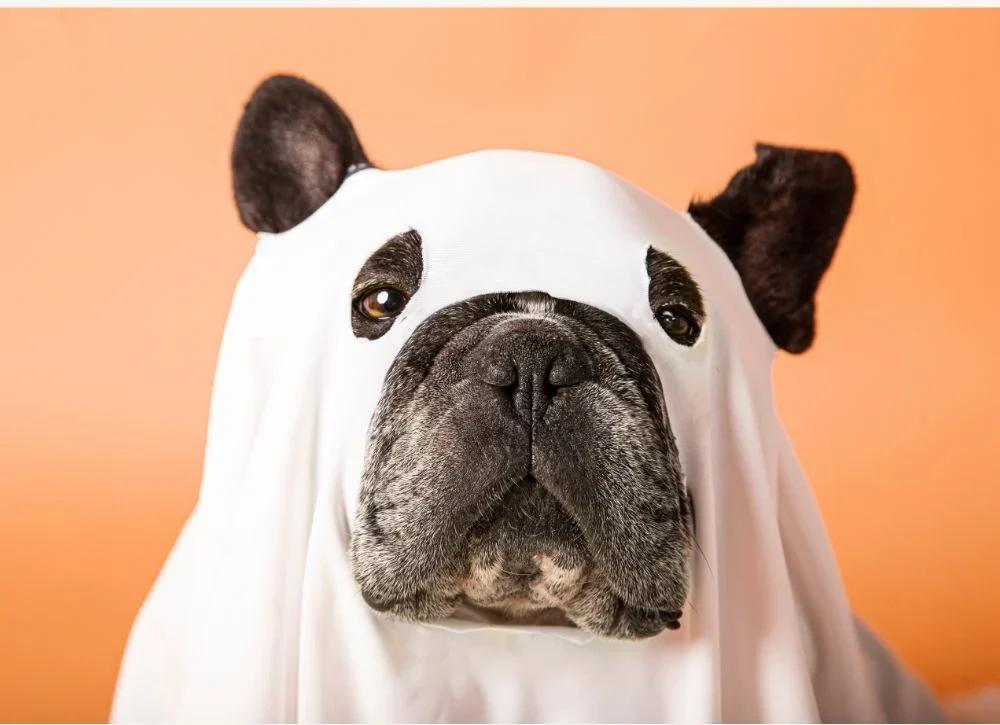
Costumes are fine for dogs who genuinely do not mind them, and a bad idea for dogs who do. The distinction is practical rather than sentimental: an uncomfortable dog tries to remove the costume, and in doing so chews off and swallows parts of it.
Try the costume on well before the night, not on the doorstep. Check that it does not restrict movement, sight, breathing or panting, and that nothing dangles where a leg can catch. Never leave a costumed dog unattended.
Watch for lip licking, yawning, a tucked tail, freezing, or simply trying to leave the room. Those are refusals rather than stubbornness, and the right response is to take the costume off. For dogs in that category, a Halloween dog bandana gives you the seasonal photo with almost none of the stress, and a DIY dog Halloween costume or our no sew pumpkin bandana and mask lets you build the fit around your own dog rather than a size chart.
Trick-or-Treaters and the Open Front Door
The door is the underrated risk. It opens repeatedly onto an overexcited dog with a dark street beyond, and a dog that bolts on Halloween is running through unfamiliar crowds in poor visibility.
Put your dog in a room away from the front door before the first knock rather than after it, and use a baby gate as a second barrier if your dog is a door-charger. Many people find it easier to sit outside with the bowl, which removes the doorbell and the door-opening entirely. Give your dog something absorbing while you do it, since a dog with a job is not listening for the gate. Our dog enrichment ideas are built for exactly this.
If you are going out trick-or-treating, leave your dog at home. Crowds, costumes, darkness and children moving unpredictably ask a lot of even a confident dog.
Halloween Decorations That Are Dangerous for Dogs
Decorations are the category people forget, because they go up days early and stop registering as new.
Glow sticks. The liquid is not usually toxic but tastes appalling, so a dog that punctures one will drool heavily and race around in distress. The casing can splinter too.

Fake cobwebs. Stringy material is among the worst things a dog can swallow, since it can bunch in the intestine rather than pass. Hang it high or skip it.
Candles and jack-o-lanterns. A wagging tail at candle height is a burn and a fire risk in one. Battery tea lights solve this completely.
Electrical cords. Extra cords for lights and animatronics mean extra chewing opportunities, and a live cord can burn a dog's mouth. Run them behind furniture or through cord covers.
Rotting pumpkins. Fresh pumpkin is fine in small amounts, but a jack-o-lantern that has sat on a porch for two weeks is growing mold, and a lump of rind can obstruct.
Fog machine fluid. Keep dogs away from the machine and its reservoir.
Put decorations up gradually if you can. A house that changes overnight unsettles a lot of dogs before anything is even chewed.
Keeping an Anxious Dog Calm on Halloween Night
For a noise-sensitive dog, the doorbell going forty times is the hardest part of the evening. Signs your dog is not coping include panting when it is not warm, pacing, hiding, trembling, refusing food they would normally take, or barking that never settles between visitors.
Set the safe room up a day or two early so it already means something good, with a bed, water, a familiar toy and the door closed. Background sound helps more than people expect, because it masks the doorbell rather than adding to it. Something long-lasting to chew gives the dog an outlet, and mental stimulation settles a dog in a way that burning energy alone does not.
If your dog has struggled badly on previous Halloweens or fireworks nights, speak to your vet in advance rather than on the day. There are options worth discussing and they need planning. That is a conversation for your vet, not for the internet.
Check Your Dog's ID and Microchip Before October 31
Halloween is one of the year's worst nights for lost dogs, for the obvious reason that doors keep opening. The fix takes ten minutes and is the highest-value thing on this page.
Confirm the collar tag is readable and carries a current number. Confirm your microchip registration lists the address and number you use now, since a chip registered to a house you left years ago is not much use. Take a fresh photo of your dog on your phone. The ASPCA's Halloween guidance makes the same point, and it is the one people skip.
Your Halloween Night Plan, Hour by Hour
A few days before. Check ID and microchip details. Set up the safe room. Try the costume on. Put decorations up gradually.
Late afternoon. Walk your dog properly while the street is quiet. This is the walk that matters, and it will not be happening later.
Before the first knock. Feed your dog. Move all candy somewhere a counter-surfer cannot reach. Settle your dog in the safe room with something to chew and background sound on.
During peak hours. Keep the dog and the door separated. Check on your dog between visitors rather than bringing them out to meet anyone.
Once it is quiet. Sweep the floor and the yard for wrappers before letting your dog back out. This catches the thing you did not see get dropped.
More Halloween Ideas for Your Dog
With the safety side handled, the fun part is easy. If there is a new puppy in the house, pick something from our Halloween dog names list while you are at it.


FAQ
Frequently asked questions
01How do I keep my dog safe on Halloween?
Settle your dog in a quiet room away from the front door before trick-or-treaters arrive, put all candy and wrappers somewhere they cannot reach, and check the collar tag and microchip details a few days beforehand. Keep decorations such as glow sticks and fake cobwebs out of reach, and call your vet immediately if any candy is eaten.
02What Halloween candy is most dangerous for dogs?
Sugar-free candy and gum containing xylitol are the most urgent, because very small amounts can cause a dangerous drop in blood sugar quickly. Chocolate is the other major risk, with dark and baking chocolate carrying more theobromine than milk chocolate. Both warrant an immediate call to your vet rather than waiting for symptoms.
03My dog ate chocolate. What should I do?
Call your vet or an animal poison control line straight away, even if your dog seems fine. Have four details ready: the type of chocolate, roughly how much was eaten, when it happened, and your dog's weight. Those determine the advice you get. Do not try to make your dog vomit unless a vet instructs you to.
04Are Halloween costumes safe for dogs?
They are safe for dogs who do not mind wearing them. Check that the costume does not restrict movement, sight, breathing or panting, and that nothing dangles loose. Never leave a costumed dog unsupervised, since an uncomfortable dog may chew off and swallow parts. Lip licking, a tucked tail or freezing are signs to take it off.
05How do I calm a dog scared of the Halloween doorbell?
Set up a safe room a day or two early with a bed, water and something long-lasting to chew, and use background sound to mask the doorbell. Sitting outside with the candy bowl removes the noise entirely. If your dog has struggled badly before, speak to your vet ahead of time rather than on the night.
06Which Halloween decorations are dangerous for dogs?
Glow sticks, fake cobwebs, lit candles, electrical cords, rotting jack-o-lanterns and fog machine fluid are the main ones. Stringy decorations are particularly risky because they can bunch in the intestine rather than pass through. Battery tea lights remove the burn risk entirely, and cord covers stop chewing on the extra wiring Halloween brings out.
Related Reading

