


Best Dog Muzzles That Fit Right
 Editor's Picks

Most people buy their first muzzle in a hurry. Usually it is the week after something went wrong on a walk, or the afternoon a vet clinic calls ahead and asks you to bring one. Rushed is exactly how the wrong muzzle ends up in the cart. The best dog muzzles are not the sturdiest or the cheapest on the shelf. They are the ones a dog can still pant inside. That one detail decides whether a muzzle is safe for a half hour walk or safe for ninety seconds on an exam table.
Put the guilt down too. Muzzles belong in the same category as seatbelts and car harnesses, and the dogs wearing them usually belong to the people taking their responsibilities most seriously.
Eight picks follow, sorted by job rather than by price, along with the sizing and conditioning work that makes any of them wearable.
8 Top Rated Dog Muzzles
Read the Type column before anything else. It tells you whether a muzzle is cleared for a walk or strictly for a few minutes of handling, and that distinction matters more than every other spec combined. Measure first, order second, using the same two measurements and size up approach set out in this dog harness buying guide.
| Muzzle | Type | Best for |
|---|---|---|
| Baskerville Ultra | Rubber basket | Everyday wear and training |
| LUCKYPAW 7-Piece Set | Soft mesh | Growing pups, multi-dog homes |
| Four Paws QuickFit | Nylon quick-fit | Vet and grooming, minutes only |
| Mayerzon Patented | Soft mesh | Scavengers on short outings |
| BUDKAS Pitbull | Leather and wire basket | Powerful, blocky-headed breeds |
| Crazy Felix Nylon | Soft mesh | Large dogs, brief wear |
| BRONZEDOG | Steel wire basket | Huskies and Dobermans |
| BONTHEE | Soft mesh | Vet visits and low light |
1
BASKERVILLE Ultra Dog Muzzle: Best Basket Muzzle Overall

Price last checked November 2026 · may vary
Trainers reach for this one more than any other, and it is the sensible first purchase for almost every dog. The thermoplastic rubber basket leaves enough room for a full pant, a drink from a puddle, and a treat pushed through the front, which is what separates a muzzle you can actually walk in from one that buys you ninety seconds at the vet. That treat gap is not a nice extra either. Feeding through the bars is the entire mechanism behind muzzle conditioning, so a dog who needs training needs this shape. It heat-shapes in hot water for a closer fit around the nose bridge, and the collar loop stops a determined paw from flicking it off halfway down the street.
2
LUCKYPAW Dog Muzzle Set: Best for Puppies and Small Dogs

Price last checked November 2026 · may vary
Seven sizes arrive in one box, which sounds excessive right up until you own a Labrador puppy whose snout changes monthly, or a household where a Chihuahua and a Collie both occasionally need one. Guessing the size wrong is the single most common muzzle mistake, and this set removes the guess for roughly the cost of one decent basket. The build is lightweight mesh, so file it under short-session equipment: nail clipping, ear cleaning, and the rest of a home grooming kit routine, not walks.
3
Four Paws QuickFit Dog Muzzle: Best Grooming Muzzle

Price last checked November 2026 · may vary
Speed is the whole point of this one. Washable nylon, one buckle, one motion, which is what you want when a dog is already braced on a grooming table and every extra second makes things worse. It holds the mouth mostly closed, so treat it strictly as a few-minutes tool: on for the clip, off the moment the clip is done. Nail work is where most owners first need it, and if your dog's nails have grown long enough to change how they stand or walk, this guide to unhealthy dog nails explains what you are looking at before you book the appointment. Never walk in it, and never put it on in warm weather.
4
Mayerzon Patented Dog Muzzle: Best for Scavengers

Price last checked November 2026 · may vary
Dogs who treat every curbside as a buffet are the target here. The patented front opening gives noticeably more room than a standard mesh wrap, enough for water and the occasional small treat, and the whole thing folds down into a coat pocket. Keep the limits in mind: soft is still soft, and no mesh muzzle gives a dog the full jaw range a basket does. Short outings in mild weather suit it. Summer hikes do not.
5
BUDKAS Pitbull Dog Muzzle: Best for Blocky Heads

Price last checked November 2026 · may vary
Standard baskets gape at the sides on a short broad muzzle, which is a real and frustrating sizing problem for Pitbulls, Staffies, Boxers and American Bullies. This is cut for that head shape. Leather straps and a wire basket give genuine security without closing off airflow, and the dog pants and drinks normally underneath. Worth knowing before you buy: metal reads differently to strangers than rubber does, and a dog in a wire basket collects assumptions that the same dog in a Baskerville would not.
6
Crazy Felix Nylon Dog Muzzle: Best Soft Muzzle for Large Dogs

Price last checked November 2026 · may vary
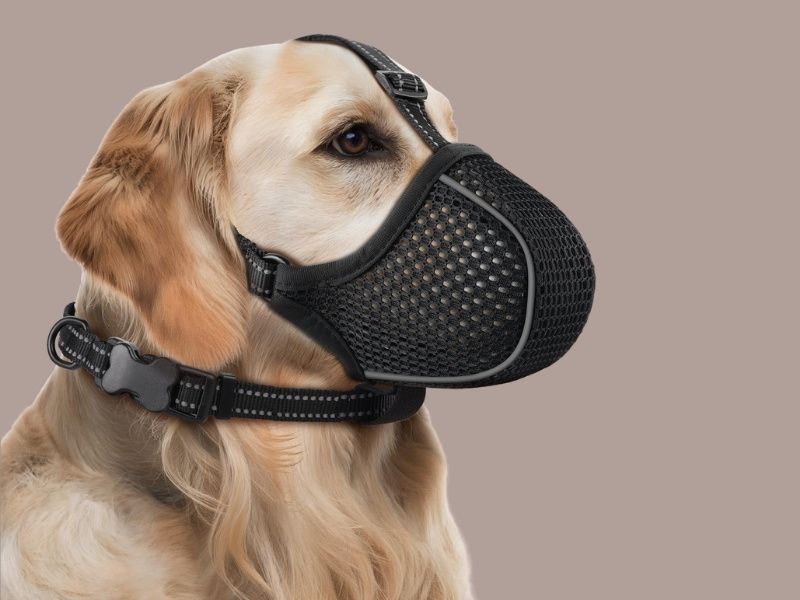
Generous sizing is the draw. Goldens, Labradors and Huskies tend to fall between sizes on cheaper mesh muzzles, and this one runs large enough to sit properly on them. The ventilated body is light enough that most dogs stop registering it within a minute or two, the open front passes treats and water, and the single strap goes on in seconds. Same trade-off as every mesh muzzle on this list, though. Short walks, cooler days, and a switch to a basket the moment your dog needs to wear something for an hour.
7
BRONZEDOG Dog Muzzle: Best Professional Wire Muzzle

Price last checked November 2026 · may vary
This is the heavy-duty option, the one to pick for a long-snouted powerful dog who needs to run in it rather than stand still in it. Stainless steel holds its shape under pressure that would flex a plastic basket out of true. Leather straps and substantial buckles stay where you put them, and the open construction means a full pant and an easy drink from a bowl. Narrower through the basket than a rubber design, which is exactly what sighthound and Doberman profiles need. It is the priciest pick here and likely the longest-lived. A dog strong enough to warrant it is usually strong enough to warrant a front-clip no-pull harness at the other end of the leash as well.
8
BONTHEE Dog Muzzle: Best Budget Pick

Price last checked November 2026 · may vary
Under ten dollars buys the spare, and a spare is genuinely useful. Keep it in the glovebox or tucked into the carrier you travel to the vet in, for the days a muzzle turns out to be needed with no warning. Fine-pore nylon mesh, reflective trim that earns its place on a winter evening, a non-slip collar attachment, and it folds flat to nothing. Soft muzzle doing soft muzzle work: fine for a grooming session or an exam, wrong for a hot afternoon.
Types of Dog Muzzles: Basket, Mesh and Wire
Nearly every muzzle mistake traces back to buying the wrong type rather than the wrong brand, so this is the section worth slowing down for.
Dog muzzles come in three types, and the difference between them is how much a dog can open their mouth. Basket muzzles form a rigid cage in rubber, plastic or wire and allow full panting, drinking and treat-taking, which makes them the only style safe for walks, exercise or any wear beyond a few minutes. Soft mesh and nylon muzzles hold the mouth mostly shut and suit short handling such as a nail trim or an injection. Wire baskets are the most secure of the three and the usual choice for powerful or long-snouted breeds.
Basket muzzles for walks and everyday wear
Severe-looking and by a wide margin the kindest thing you can put on a dog. The rigid cage holds its shape away from the nose and teeth, so the jaw opens freely underneath. Panting is not a comfort detail either, it is how a dog sheds heat, and a muzzle that blocks it turns a warm day into a risk. Any dog who needs a muzzle more than occasionally should be in a basket. Rubber and TPR designs are the friendliest to live with, lighter than wire and softer against the face, and the good ones soften further in hot water so you can press them to your own dog's nose bridge.
Soft mesh and nylon muzzles for short handling
Light, packable, cheap, and widely misused. These wrap the snout and hold the mouth closed, which is precisely the problem: a dog who cannot pant cannot cool down, and a dog who cannot open their mouth cannot drink or take a treat that might make the experience survivable. Keep them to supervised indoor minutes. If what you are planning sounds anything like a walk, the answer is a basket instead.
Wire and leather muzzles for powerful breeds
Strength and shape are what wire buys you. A steel basket will not flex out of position under a determined push, and the narrow profiles available in wire fit long-snouted dogs that a wide rubber basket perches awkwardly on. Leather straps last longer than nylon and sit softer behind the ears, though they need the occasional wipe and condition rather than a run through the washing machine. The cost is weight, price, and the way people look at a dog wearing one.
Snout shape: sighthounds, flat faces and blocky heads
Snouts are not uniform, which is why breed-shaped muzzles exist at all. Greyhounds, Whippets and Dobermans want a long narrow basket that clears the eyes and does not press the cheekbones. Flat-faced breeds need mask-style designs and far more care generally, because a dog who already works hard to breathe has no margin left to give away. Blocky-headed breeds need a wider basket than their body weight would suggest, which is the entire reason a purpose-cut option like the BUDKAS exists. This guide to whether French Bulldogs are aggressive goes further into the flat-faced side of the question.
Dog Muzzles for Grooming, Nail Trims and Vet Visits
Handling is where most dogs meet a muzzle for the first time, and it is a different job from walking. The work is short, the dog is usually standing still, and someone else's hands are on them. Speed and a predictable fit matter more than long-wear comfort.
Choosing a grooming muzzle that goes on fast
Buckles beat straps when a dog is already uneasy. Fumbling with three adjustment points while a Spaniel twists away from the clippers undoes any calm you had built, so a quick-fit nylon design earns its keep for nail trims, ear cleaning and dematting. Size it before the appointment, not during. One note that catches people out: a soft muzzle stops teeth, not a tongue, so licking and a certain amount of chewing at the fabric carry on regardless.
What to tell your groomer or vet nurse
Say it in advance rather than at the door. Mentioning that your dog has a bite history, or hates having their back feet touched, or panics at the nail grinder, lets the clinic plan the appointment rather than improvise it. Bring your own muzzle if your dog is already conditioned to one, because a familiar muzzle in a strange place is a much smaller ask than a strange muzzle in a strange place. Ask how long it will be on, and ask for it to come off between procedures.
Muzzles for Aggressive and Reactive Dogs
Start with the word itself. Most dogs described as aggressive are frightened rather than dangerous, and the distinction changes what you need. A dog who has bitten, or come close, needs equipment that holds under real force. A dog who barks and lunges but has never made contact needs the same equipment, because the point is removing the possibility rather than passing judgment on the dog.
What holds under a real bite risk
Three things decide it. A rigid basket in wire or hard rubber rather than anything fabric. A fit snug enough that the muzzle cannot be shoved off against a knee or a fence post. And a second attachment point, an overhead strap or a collar loop, so that one failure is not the whole failure. Both the BRONZEDOG and the Baskerville Ultra meet that bar. Fabric does not stop a committed dog and should never be the answer to a bite risk.
Muzzle work alongside behavior training
Management and training are two different jobs, and a muzzle only does the first one. Nothing about the dog's feelings changes because their mouth is covered, which is why the behavior work has to run in parallel. Keeping a dog under threshold is the core of it, and the approach in this resource guarding guide transfers directly to reactivity around other dogs and people.
Leash tension makes all of it harder. Where the lunging happens mainly on walks, these tips to stop leash pulling give you back the handling control that makes training possible in the first place.
How to Fit and Introduce a Dog Muzzle
Badly fitted is worse than nothing. It either slips off at the exact moment it mattered, or it quietly stops your dog panting while you assume everything is fine. Ten minutes and a soft tape measure prevent both.
Measuring your dog's snout for the right size
Two measurements do it. Take the snout length from just below the eyes to the tip of the nose, then the circumference around the widest part of the snout with the mouth closed. Add about half an inch to that circumference so your dog can open up inside the basket. Between two sizes, size up. A correct fit sits clear of the eyes, leaves a gap at the end of the nose rather than pressing against it, and lets the jaw open properly when your dog pants.
Comfort checks that prevent rubbing and chafing
Check the face after the first few wears, before a sore spot becomes a reason your dog refuses the muzzle forever. Run a finger along the nose bridge and under the straps, looking for flattened fur, pink patches or any mark that stays visible a few minutes after the muzzle comes off. Padding at the bridge solves most of it, and so does loosening the overhead strap by a notch. A dog who starts pawing at a muzzle they previously tolerated is usually telling you something rubs, not that the training has fallen apart.
Introducing a muzzle without a fight
Do this weeks ahead, never on the day. Let your dog sniff the muzzle and pay them well for the interest. Smear something good inside the basket and let them push their own nose in, with nothing fastened. Fasten it for two seconds, then five, then a walk to the end of the driveway, paying generously throughout and always stopping while your dog is still comfortable rather than once they have had enough.
Order matters more than speed. If the first appearance of a muzzle is at a vet's door, your dog learns that muzzles predict frightening things, and you will be fighting that association for years. Reward-based conditioning is the only approach worth using, and veterinary behavior professionals are clear that aversive methods have no useful role in work like this. Your dog will tell you when to slow down long before they tell you loudly, and this guide to reading what your dog is telling you covers the signals worth knowing.
Keep early sessions to twenty or thirty minutes, never leave a muzzled dog unsupervised, and take it off as soon as it has done its job. Done properly, most dogs end up completely indifferent to the thing, which is the entire goal.
Cute Dog Muzzles and Color Choices
Appearance is not vanity here. How a muzzle looks changes how strangers behave around your dog, and how strangers behave around your dog changes how hard your walks are.
Why a bright muzzle changes how strangers react
Black wire on a black dog reads as a warning. The same dog in a cherry red or sky blue basket reads as a dog whose owner is organized, and people respond to that difference in ways you notice within a week. Plenty of basket muzzles now come in colors for exactly this reason, and some owners add a bright strap or a patterned collar to shift the impression further. None of it changes the muzzle's job. It changes the odds that an oncoming walker gives you room instead of an opinion.
Decorating and customizing a basket muzzle
Rubber and plastic baskets take decoration well. Pet-safe paint, colored tape along the bars, a small charm clipped to the side strap, all of it is common in muzzle-training circles and none of it interferes with the fit if you keep the nose opening and the bars clear. Two rules hold: nothing that narrows the opening your dog pants through, and nothing small enough to come loose and be swallowed. Check decoration after every wash the way you would check a collar for fraying.
FAQ
Frequently asked questions
1What muzzles do vets recommend?
Basket muzzles, for anything beyond a moment of handling. Cornell's Riney Canine Health Center sets out the distinction plainly in its guidance on muzzle choices: basket styles are best for extended use because a dog can pant normally, drink and take treats in one, while soft or sleeve muzzles are temporary tools for jobs like nail trims.
2How long can a dog wear a muzzle?
Keep early sessions under twenty to thirty minutes and never leave a muzzled dog alone. Once a dog is genuinely comfortable, a well-fitted basket muzzle can stay on for a full walk. Soft mesh muzzles are a minutes-only proposition at any stage, because they restrict panting.
3Can dogs drink water while wearing a muzzle?
In a basket muzzle, yes. The open construction lets a dog lap from a bowl or a puddle and take treats pushed through the front, which is a large part of why the style is considered safe for longer wear. Soft mesh muzzles hold the mouth closed and make drinking difficult to impossible.
4Will a muzzle stop my dog from barking?
Not reliably, and it is the wrong tool for the job. A basket muzzle leaves the mouth free enough to bark normally. Muzzles that clamp the jaw shut enough to muffle sound also block panting, which makes them unsafe to leave on. Barking is a training and management question rather than an equipment one.
5Is it cruel to put a muzzle on a dog?
A properly fitted basket muzzle, introduced slowly with food and never used as punishment, is not cruel. What is cruel is a muzzle that prevents panting, one forced on at the worst possible moment, or one used to keep a dog in situations they are visibly not coping with.
6How tight should a dog muzzle be?
Snug enough that it cannot be pushed off against a leg, loose enough that the jaw opens fully. You should be able to slip a finger under the neck strap. The basket itself should sit clear of the eyes and leave space in front of the nose rather than resting on it.
Related Reading


Share a thought, ask a question, or tell us about your own dog. We read every comment.