


Labradoodle vs Goldendoodle: Which Doodle Fits?
 Dog Breeds
A Labradoodle and a Goldendoodle share one parent, the Poodle, so the real difference sits in the other half of the family tree. The Labradoodle vs Goldendoodle decision is really a choice between a Labrador's bounce and a Golden Retriever's softness, wrapped in a curly coat that may or may not behave the way the breeder's photos promise.
Both crosses are now household names. In Australia, the Groodle (the local name for the Goldendoodle) sits among the most popular dog breeds in the country, with the Labradoodle not far behind. Here is how they compare on coat, temperament, health and daily care.
Goldendoodle or Labradoodle: The Main Differences

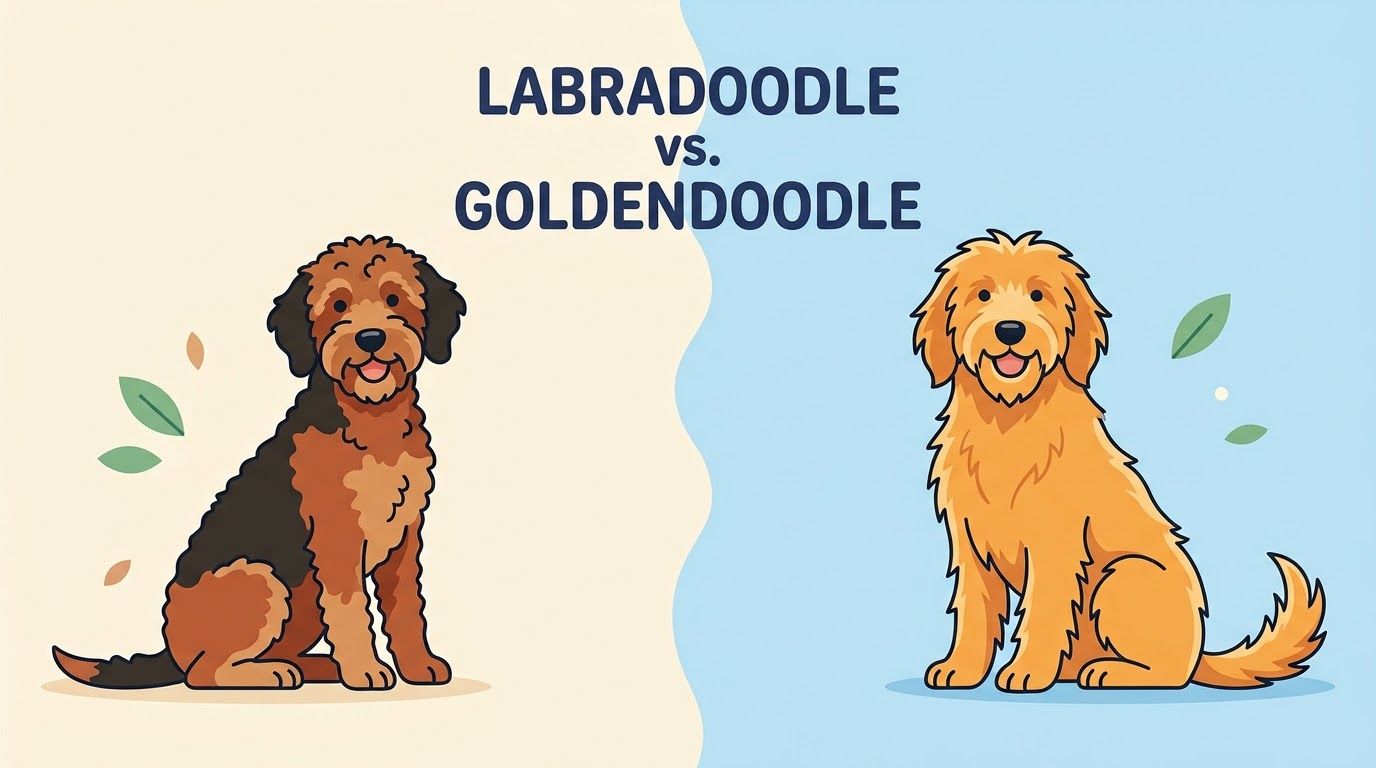
The main difference between a Labradoodle and a Goldendoodle is the non-Poodle parent: a Labradoodle is a Labrador Retriever and Poodle cross, while a Goldendoodle is a Golden Retriever and Poodle cross. Labradoodles tend to be more energetic and task-focused, with a broader head and a shorter coat on average. Goldendoodles are often softer, more sociable with strangers and quicker to settle at home. Both come in mini, medium and standard sizes and usually live around 12 to 15 years.
Doodle Parent Breeds and Where They Came From
The Labradoodle came first. In the late 1980s, Wally Conron of the Royal Guide Dogs Association of Australia in Victoria crossed a Labrador with a Standard Poodle to produce a guide dog for a vision-impaired woman whose husband was allergic to dogs. He later said he regretted the craze it started.
The Goldendoodle followed in the 1990s, when breeders in the United States and Australia swapped the Labrador for a Golden Retriever. Both crosses lean on the Poodle for brains as much as coat, which makes sense for a breed that ranks near the top of the smartest dog breeds.
Doodle Size From Mini to Standard
Size follows the Poodle parent more than the breed name. A Standard Poodle produces a standard doodle, while a Miniature or Toy Poodle produces medium and mini dogs. Standards of both crosses usually stand about 20 to 24 inches at the shoulder. Labradoodles often look stockier, with a deeper chest and heavier bone, while Goldendoodles can run a little taller and leaner, and big standard Goldendoodles commonly pass 70 pounds. A full-grown standard of either cross belongs firmly among big dog breeds.
Doodle Face, Build and Coat Colors
Side by side, the Labradoodle usually has a broader head and a squarer muzzle from the Lab, while the Goldendoodle's face is longer and finer, often framed by a shaggier beard and eyebrows. Colors follow the parents too. Labradoodles commonly come in black, chocolate, caramel, red, apricot and cream, while Goldendoodles lean toward gold, apricot, red and cream.
Take care with merle. Neither Labradors nor Golden Retrievers carry the merle gene, so a merle doodle inherited it from a merle Poodle or from another breed somewhere in the line. Two merle parents should never be bred together, because double merle puppies are at high risk of deafness and eye defects, so ask about both parents' colors.
Doodle Dog Breed Profiles at a Glance
Individual dogs vary more within each cross than between them, so treat these as starting ranges and ask for the parents' actual sizes.
Labradoodle Breed Snapshot

- Height (standard): about 21 to 24 inches at the shoulder
- Weight (standard): roughly 50 to 65 pounds, with minis often 15 to 30 pounds
- Lifespan: typically 12 to 15 years
- Bred for: guide and assistance work
- Notable trait: high energy and a strong urge to have a job
Labradoodles thrive with owners who walk, hike or train every day, and they sit comfortably among the best dog breeds for active people.
Goldendoodle Breed Snapshot

- Height (standard): about 20 to 24 inches at the shoulder
- Weight (standard): roughly 50 to 90 pounds, with minis often 15 to 35 pounds
- Lifespan: typically 10 to 15 years
- Bred for: family companionship and therapy work
- Notable trait: gentle, people-loving and quick to warm to strangers
That easy, forgiving nature is why Goldendoodles often appear among the best dogs for first-time owners, as long as the grooming is part of the plan.
Doodle Shedding, Coat Types and Grooming
The coat is the main reason people choose a doodle, and the least predictable part. Generation matters more than whether the other parent was a Lab or a Golden.
Fleece, Wool, Wavy or Flat: Doodle Coat Types
Three genes do most of the work: one for curl, one for the beard and eyebrows known as furnishings, and one linked to shedding. A puppy with furnishings and some curl usually grows a low-shedding wavy or fleece coat. A puppy without furnishings grows what breeders call an improper or flat coat, which looks and sheds much like a retriever's. This guide to curly haired dogs explains how the curl gene works across breeds.
Labradoodle coats are described as hair, fleece or wool. Goldendoodles are more often grouped as straight, wavy or curly, with wavy giving the classic teddy bear look.
Which Doodle Sheds Less, and Does It Help Allergies?
Neither cross wins outright. A first-generation (F1) doodle is half Poodle and the most likely to shed. An F1B puppy, bred back to a Poodle, and multigenerational doodles carry more Poodle coat genes and shed less on average. F1 Labradoodles in particular can inherit the Lab's dense, short coat, which sheds steadily, while flat-coated Goldendoodles drop long golden hair.
Low shedding is not the same as hypoallergenic. The proteins people react to live in dander and saliva, which every dog produces, so anyone with allergies should spend real time with the parents before committing. Even a low-shedding doodle leaves some fur behind, and these pet hair remover tools handle what lands on the sofa.
Grooming a Doodle Coat at Home
Both doodles need brushing down to the skin several times a week, and daily for curly or fleece coats. Mats form fastest behind the ears, under the harness and in the armpits. A slicker brush followed by a metal comb is the core kit, and this roundup of the best dog brushes covers both.
Brush out tangles before every bath, because water tightens mats, then dry the coat completely. This guide to bathing a dog at home walks through the routine.
Most doodles also need a professional groom every six to eight weeks, and a short puppy cut makes upkeep far easier between visits. Hairy, floppy ears trap moisture in both crosses, so check and clean them weekly.
Labradoodle and Goldendoodle Temperament
Both are friendly, clever and devoted to their people, and neither makes much of a guard dog. The differences are matters of degree, but a consistent pattern shows up.

The Busy, Task-Loving Labradoodle

Labradoodles tend to bring the Lab's enthusiasm at full volume. They are bouncy, playful and often more energetic indoors, especially in their first two or three years. Many are happiest with a job, whether that is retrieving, agility or service work, and some are a little more reserved with strangers while staying closely bonded to their own family. The Lab's appetite often comes along too, so weight control matters.
The Gentle, Social Goldendoodle
Goldendoodles usually settle a little sooner and greet the world with open affection, strangers included. That softness makes them popular therapy dogs. The flip side is sensitivity: a Goldendoodle can take a harsh word to heart and tends to struggle when left alone for long stretches.
Training Either Doodle Puppy
Both crosses learn fast, which means bad habits stick just as quickly as good ones. Jumping up, mouthing and pulling on the leash are the classic doodle puppy problems. Short, upbeat sessions with food rewards and early positive reinforcement training suit both, though a Labradoodle may need a little more structure to channel its energy.
Doodle Health Problems and DNA Testing
A doodle can inherit conditions from either side, so testing on the parents matters far more than the promise of hybrid vigor.
Labrador-Side Conditions in Labradoodles
Hip and elbow dysplasia are the main orthopedic concerns. Labradors can also carry exercise-induced collapse, a genetic condition in which a dog becomes weak and wobbly after intense exercise, and centronuclear myopathy, an inherited muscle disease. Both have DNA tests, so a Labradoodle breeder should be able to show results for the Lab or Labradoodle parent.
Golden Retriever-Side Conditions in Goldendoodles
Golden Retrievers have one of the highest cancer rates of any breed, and that risk can pass to Goldendoodles. Goldens are also prone to subvalvular aortic stenosis, an inherited heart condition best screened by a veterinary cardiologist, as well as hip and elbow dysplasia and a scaly skin condition called ichthyosis. Ask for heart, hip, elbow and eye clearances on the Golden parent.
Shared Poodle Health Risks
Progressive retinal atrophy, which causes gradual vision loss, can be carried by all three parent breeds. From the Poodle side, both doodles can also inherit Addison's disease, epilepsy and von Willebrand disease, a bleeding disorder. Ear infections are common in both crosses thanks to hairy ear canals. Keeping either dog lean protects those joints, and if the waistline has crept away, these picks for dog food for weight loss are a sensible place to start, alongside a chat with your vet.
Exercise Needs for Lab and Golden Doodles
Daily Activity for Each Doodle Breed
A standard Labradoodle usually needs at least an hour of exercise a day, and many want more. Goldendoodles often settle on a little less, though most still need around an hour split between walks and play. For rainy days and busy weeks, these boredom busters keep a clever doodle's brain occupied, which matters as much as mileage. Skip long runs until growth plates close.
Can a Doodle Live in an Apartment?
A mini of either cross can be happy in an apartment with daily walks and play. A standard Labradoodle is the harder fit for small spaces, while a calm adult Goldendoodle may adapt better. Breeds built for smaller homes are gathered in this list of the best apartment dogs.
Other Doodle Breeds in the Comparison
Australian Labradoodle and Goldendoodle
An Australian Labradoodle is not simply a Labradoodle bred in Australia. It is a multigenerational dog that adds other breeds, most often the Cocker Spaniel, to the Lab and Poodle mix. Bred for a fleece or wool coat and a calmer temperament, an Australian Labradoodle often sits closer to a Goldendoodle in personality than a first-generation Labradoodle does.
Mini Labradoodle or Mini Goldendoodle
Both minis come from a Miniature or Toy Poodle parent and usually weigh 15 to 35 pounds. They keep the same personality split as the standards, packed into a smaller body. Adult size is harder to predict in minis, so meet both parents.
Where the Bernedoodle Fits In
The Bernedoodle, a Bernese Mountain Dog and Poodle cross, is the third doodle families often weigh up. It tends to be calmer and more laid-back than either retriever doodle,. The Bernese side brings a shorter lifespan and a high cancer risk, so health testing matters just as much.
Choosing the Right Doodle Breed for Your Family
When a Labradoodle Is the Better Fit
A Labradoodle suits active households that want a sporty, trainable partner for hikes, runs and dog sports. It also suits owners who enjoy training and want a dog with real drive.
When a Goldendoodle Is the Better Family Dog
A Goldendoodle suits families who want a softer, more social companion that settles a little sooner and loves meeting new people. It often edges ahead for first homes and households with young children, and holds its own among the best family dogs.
For homes with toddlers, this guide to dog breeds for kids covers what to look for in temperament and size.
Finding a Responsible Doodle Breeder or Rescue
Many doodles end up in shelters when families underestimate the grooming or the energy, so a rescue is well worth considering. This piece on whether to get a rescue dog is a good place to start.
If you go to a breeder, ask to see hip and elbow scores, eye exams and DNA results for both parents, plus heart screening for Goldens and exercise-induced collapse testing for Labs. Ask about coat testing for furnishings, and be wary of hypoallergenic guarantees, rare color premiums or any breeder who will not let you meet the mother. The Merck Veterinary Manual has a clear overview of exercise-induced collapse in dogs that is worth reading before a Labradoodle breeder visit.
Labradoodle or Goldendoodle, the right doodle is the one whose energy, coat and needs match the life you actually live. Choose the parents carefully, keep the brush close, and enjoy one of the most affectionate companions a sofa can hold.
Related Reading


Share a thought, ask a question, or tell us about your own dog. We read every comment.