


How to Use a Dog Nail Grinder
 Health & Wellbeing
Written by
Shell & KatyUpdated 1 September 2026 · 7 Min Read
Shell & Katy are two style-savvy dog mums celebrating the best in pet-friendly living. A pet photographer and dog lifestyle writer, together they share trending pet products, recipes, inspiration and expert tips with discerning dog lovers around the world.
Click clack, click clack. If that sound follows your dog across the floorboards, their nails are overdue. Learning how to use a dog nail grinder is the gentlest way to fix it, and often the answer for pups who have already decided that clippers are the enemy.
A grinder files the nail down in tiny amounts instead of cutting through it, so there is no squeezing and far less chance of catching the quick. The technique is genuinely different from clipping, and getting it right comes down to patience rather than strength. Any decent tool will do the job, and we have ranked our favorites in our guide to the best dog nail grinders.

Dog Nail Grinding vs Clipping
Clippers are faster and silent, but every cut is a commitment. On thick or dark nails you are guessing where the quick sits, and a guess that goes wrong bleeds. Our roundup of the best dog nail clippers compares the styles if that is still your preference.
Grinding takes longer and makes a noise some dogs hate. In exchange you remove a fraction of a millimeter at a time, you can stop the instant the quick appears, and the nail is left smooth instead of squared off. For dark nails, thick nails, and dogs with a bad clipping memory, the extra minutes are worth it. The risks are specific rather than general: the spinning head catches long paw hair and can burn skin if it slips, which is why VCA Animal Hospitals advises holding hair back and working in short bursts.
Filing Dog Nails Without a Grinder
There is a third option, and it is the right one for some dogs. Filing dog nails by hand suits small dogs, thin nails, and pups who will not tolerate a motor near them. It is slower, but it is silent, there is no heat, and there is almost no way to take off too much by accident. Use a coarse emery board or a dedicated dog nail file rather than a fine human glass file, which will not make progress on a dog nail. Work in one direction across the tip and check the face every few strokes for the same dark circle you would watch for with a grinder. Some dogs will also file their own front nails on a scratch board, which is worth trying if paw handling is the sticking point.

How to Grind Dog Nails Step by Step
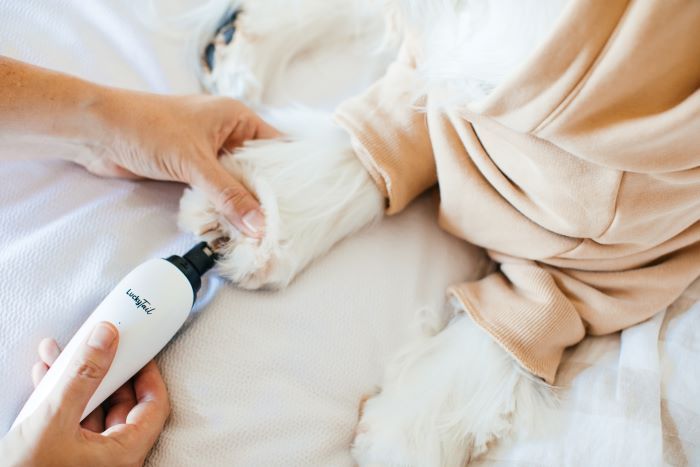
To grind your dog's nails, hold the paw firmly and push the hair back from the toe, then rest the grinder against the tip of the nail for a second or two and lift away. Check the cut face, then repeat. Work underneath the nail first and then across the tip, following its natural curve, and stop as soon as a small dark circle appears in the center of the cut surface. That circle is the quick. The method is the same on any brand of grinder.
Across a full session:
- Set up somewhere calm and well lit, with treats within reach before you start.
- Sit beside your dog rather than nose to nose, or tuck a small pup between your knees.
- Turn the grinder on before it touches anything, letting it run at a distance so the sound is old news. For a beginner dog, that deserves a few days on its own.
- Hold the paw and clear the hair, gentle but firm, working toe separated from the others. Long paw hair is the main hazard.
- Touch, then lift. A second or two of contact, then off. Any longer and friction builds heat the dog feels through the nail.
- Check between every pass, and reward after each nail rather than keeping your dog busy through it.
All four paws in one sitting is a bonus, not a target.

Grinding Black Dog Nails: How to Find the Quick
On pale nails the quick shows through as a pink shadow and you stay clear of it. On black nails you get no warning from the outside, which is exactly why a grinder beats clippers here.
The trick is to stop reading the side of the nail and start reading the face of it. After each short pass, turn the paw and look straight at the surface you have just ground. It starts out chalky and even, and as you close in on the quick a small dark circle appears in the middle of it, ringed by paler nail. That is your stop sign, and it shows up well before you reach anything sensitive.

What to Do When Your Dog Is Scared of the Grinder
Most grinder fear is really noise fear, and it responds well to being taken slowly. Leave the grinder out switched off and reward your dog for investigating it. Over the next few days, switch it on across the room and reward them for staying relaxed while it runs. Only once that is boring do you bring it near a paw.

One thing worth unlearning: do not distract your dog through it. Smearing peanut butter on a lick mat and grinding while they are busy feels kind, but VCA's guidance on stress-free nail trims is clear that tricking a worried dog into being handled damages trust and usually makes the fear worse. Reward after each nail instead.
Watch the quiet signals too: looking away, yawning, leaning back, shaking off when they are not wet. Those mean slow down. If your dog is genuinely panicked, talk to your vet or groomer, and know that some dogs need a sedated trim before home care is possible at all. The same patience pays off across every fiddly grooming job, from nails to cleaning your dog's ears.
Pretty Fluffy Recommends

LuckyTail Pet Nail Grinder. A quiet, low-vibration motor makes this an easy first grinder for anxious dogs, and the safety cap helps steady the nail while you work.
CHECK PRICE ON AMAZON >> LuckyTail Nail Grinder

How to Trim Dog Nails That Are Overgrown
Overgrown nails are a different job, because the problem is not only the nail. When a nail grows long the quick grows out with it, so you cannot take it back to a normal length in one session however careful you are.
If a nail has curled far enough to press into the paw pad, that is a vet or groomer visit, not a home job. For nails that are long but not curling, take the very tip off first, then grind to shape and smooth what is left. Our guide to unhealthy dog nails covers the warning signs worth checking first.
Getting the Quick to Recede
Here is the part most guides skip. The quick pulls back on its own if the nail is kept consistently short, so overgrown nails are fixed on a schedule rather than in a session.
Grind a small amount off each nail once a week, not all in one heroic go. Over several weeks the quick retreats behind the shortening nail, giving you a little more to work with each time. Depending on where you started it can take a month or two, and that is normal.
If you do catch the quick it will bleed more than seems reasonable, and it will stop. Press styptic powder into the nail tip, hold it, and end the session on a treat. Call your vet if the bleeding does not settle.
Final Thoughts
Short sessions, a second or two per nail, a check between every pass, and a treat at the end will move most dogs from click-clacking to comfortable within a few weeks. If home grinding turns out not to suit your dog, a groomer or vet nurse can take it on.
While you have your dog in your lap, it is worth knowing why dogs lick their paws and how to check them for ticks. And if the click-clacking has marked your floors, these cleaning tips every dog owner should know will help.
FAQ
Frequently asked questions
01How often should you grind your dog's nails?
Every three to four weeks suits most dogs, depending on how fast the nails grow and how much they wear down on pavement. Weekly is better while you are working overgrown nails back. The simplest rule is the one you can hear: if the nails click on hard floors, they are ready.
02Does grinding a dog's nails hurt?
Not when it is done properly. The nail itself has no feeling, so grinding only hurts if you reach the quick or let friction heat build up. Short bursts of a second or two, with a check between each, keeps you clear of both. A dog who flinches is usually reacting to the vibration rather than to pain.
03Can you use a nail grinder on a puppy?
Yes, and starting young is a gift to your future self. Puppy nails are thin, so use the lowest speed and the briefest contact. Spend more time on handling paws and building comfort with the sound than on removing nail. A puppy who finds the grinder boring becomes an easy adult dog.
04How long does it take to grind a dog's nails?
For a dog who is used to it, ten to fifteen minutes covers all four paws. A dog still learning may manage a nail or two before losing patience, and that is fine. Stopping while it is still going well is what makes the next session shorter.
05Is a grinder better than clippers for a large dog?
Usually, yes. Large breeds tend to have thick, hard nails that need real pressure to clip, and that pressure is uncomfortable through the toe. A grinder removes the same nail without squeezing it. Look for a stronger motor and higher speed settings.
Need dog grooming accessories? Shop small!
Dog shampoo, conditioner, nail trimming tools and more, from emerging and established small dog businesses, are all in the Pretty Fluffy Dog Lovers Directory.


Related Reading


Share a thought, ask a question, or tell us about your own dog. We read every comment.