


11 Best Slow Feeder Dog Bowls for Fast Eaters
 Editor's Picks

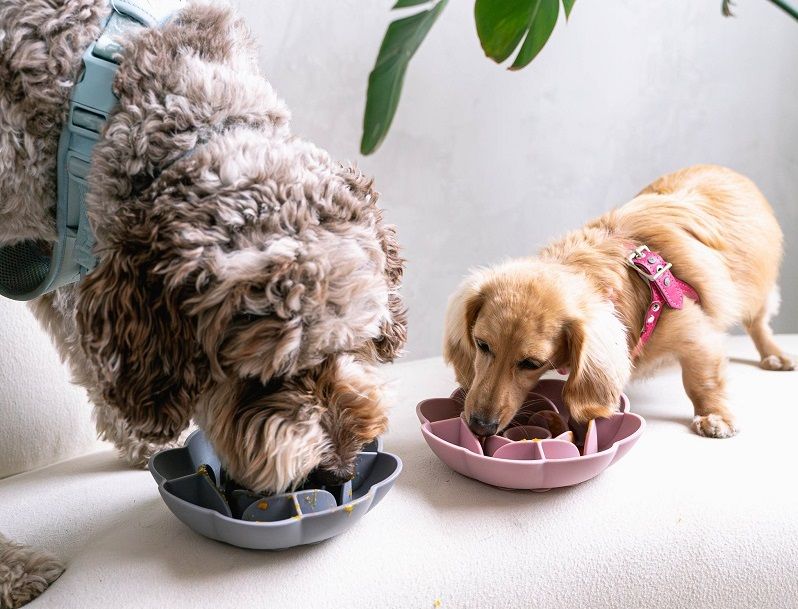
Ten seconds. That is roughly how long dinner lasts for a dog who treats a bowl of kibble as a race, and it is usually the burping or the small puddle of returned food on the rug that sends an owner looking for a fix. A slow feeder dog bowl is the cheapest one going. The maze molded into the base breaks a meal into dozens of small mouthfuls, so the dog works around the ridges instead of clearing the lot in one go.
The eleven below are grouped by what they are made of, because material decides almost everything that matters day to day: how deep the maze can be, how well the bowl stays put, and how quickly it comes clean. If your dog eats at a civilized pace and you simply need something sturdy, these dog bowls cover that instead.
How a Slow Feeder Bowl Slows a Fast Eater
A slow feeder works by taking away the open surface. Instead of one wide pool of food, the kibble sits in narrow channels between raised ridges, pillars or petals, and a dog can only lift out a few pieces at a time. A small crossover trial by a veterinary nursing researcher found dogs took significantly longer to finish a measured ration from a go-slow feeder than from a standard bowl, and ate at a significantly lower rate while they did it. That is the whole mechanism. No part of it is medical.
The side effect is the interesting bit. Nosing food out of a maze is low-grade foraging, and a dog who has to think for four minutes before breakfast tends to settle better afterwards. It is the same logic behind most boredom busters for dogs, just applied to a meal the dog was getting anyway.
Plenty of dogs who gulp are under-occupied the rest of the day, so a slow feeder works best alongside a sniffy walk and a rotation of dog toys rather than instead of them.
Do Slow Feeders Prevent Bloat?
No, and any bowl sold on that promise is overselling itself. Gastric dilatation volvulus, the twist of a gas-filled stomach that owners call bloat, is a surgical emergency with no single cause. Cornell lists eating too quickly among the risk factors, alongside breed size, a deep chest and a close relative who has had it. But a published review of the research found that most of the studies looking specifically at eating speed saw no significant effect on risk, and concluded the evidence is not strong enough to settle the question either way.
So the honest version is this: slowing a meal down is a sensible thing to do for a deep-chested dog, it costs about as much as a bag of treats, and it is nowhere near a substitute for knowing the signs of bloat or for talking to your vet about a preventive gastropexy if your breed is high risk. Raised bowls have been linked to higher GDV risk in large and giant breeds, which is why none of the picks here sit on a stand.
Do Vets Recommend Slow Feeders?
Commonly, yes, for the everyday problems rather than the dramatic one. Vets and vet nurses suggest them for dogs who regurgitate undigested food shortly after eating, for dogs who swallow enough air to burp their way through the evening, for dogs on a measured diet where a thin layer of kibble spread through a maze looks far more generous than the same amount in a dish, and for dogs who guard a bowl because it empties so fast that every meal feels urgent.
What you will not hear from a vet is that the bowl fixes anything on its own. A dog who suddenly eats like it has never been fed is worth examining, because parasites, diabetes and several hormonal conditions all drive appetite up. Get the change checked first, then buy the bowl.
Slow Feeder Bowl Types at a Glance
| Material | Maze depth | Stays put | Best suited to |
|---|---|---|---|
| Plastic | Deepest and sharpest | Rubber feet, light | Determined gulpers, long snouts |
| Silicone | Shallow to medium | Grips the floor itself | Wet food, puppies, flat faces |
| Ceramic | Medium | Heavy enough to ignore | Bowl shovers, chewers |
| Stainless steel | Medium | Heavy, often double walled | Hygiene first, long-term use |
Plastic and Silicone Slow Feeder Bowls
Plastic takes a mold better than anything else, which is why the hardest mazes on the market are plastic and why they cost so little. The trade-off is that the surface scratches with years of scrubbing, and scratches hold onto grease. Silicone goes the other way: softer ridges, kinder on teeth, and the body of the bowl grips tile without needing feet.
1
Outward Hound Fun Feeder Slo Bowl

Price last checked November 2026 · may vary
The one most people end up with, and for good reason. The ridges run tall and close together, the patterns range from a gentle spiral to a fiddly flower, and it comes in more than one size so you can match the channel width to the snout. Rubber feet keep it still on tile. Expect it to look tired after a couple of years of dishwasher cycles, and expect a committed chewer to take the edges off the bumpers.
2
Frisco Non-Skid Slow Feeder Dog and Small Pet Bowl

Price last checked November 2026 · may vary
Shallower channels and a smaller footprint, which makes this the sane starting point for a little dog or a young one. A puppy meeting its first maze does not need the hardest version, and a bowl that feels solvable keeps the puppy eating. Worth slotting into a new puppy checklist if your pup already treats breakfast as a competitive event.
3
Wilderdog Non-Skid Silicone Slow Feeder Dog Bowl

Price last checked November 2026 · may vary
Soft food-grade silicone that holds its position on a smooth floor, folds flat enough for a car trunk, and takes a rinse without complaint. The ridges are rounded rather than sharp, so a determined Labrador will not be slowed as much as hard plastic would slow it, but it is gentle on older teeth and it travels beautifully. Sits comfortably alongside the rest of these sustainable pet products if that is how you shop.
4
CHEWFFON Silicone Slow Feeder Lick Bowl

Price last checked November 2026 · may vary
Half bowl, half lick mat. The texture is fine and shallow, which suits anything spreadable better than it suits dry kibble, and it is the pattern that works for a short-nosed dog who cannot reach into a deep channel. Owners of French bulldogs and pugs tend to land here after a tall-ridged bowl leaves half the dinner behind.
5
Awoo Lick Dish Silicone Lick Mat Slow Feeder

Price last checked November 2026 · may vary
A proper raised rim is what sets this apart from a flat mat, because it keeps wet food in the dish instead of on the baseboard. Freeze it with a layer of something soft and a ten second meal becomes fifteen minutes of licking, which is one of the easier ways to add mental stimulation for dogs to a day that is already full.
Ceramic and Stainless Steel Slow Feeders
Weight is the argument for both. A ceramic or steel bowl is too heavy for a dog to shove across the kitchen, and neither material scratches the way plastic does, so neither picks up the faint smell that an old plastic bowl develops. They cost more, and ceramic chips if it lands on tile, which is the only real catch.
6
LE TAUCI Ceramic Slow Feeder Dog Bowl

Price last checked November 2026 · may vary
The best ceramic slow feeder dog bowl here, mostly because the maze is properly molded rather than token. Glazed stoneware wipes clean, goes in the dishwasher, and weighs enough that a dog shoving at it gets a scrape of ceramic on tile rather than a bowl halfway down the hall. It is also the answer for dogs who chew plastic bumpers off for sport.
7
vancasso Slow Feeder Dog Bowl

Price last checked November 2026 · may vary
Prettier than most ceramic feeders and happy to sit out in a kitchen where everything else matches. The maze is moderate rather than punishing, so it suits a dog who eats briskly more than one who truly inhales, and the glaze holds up to the dishwasher several times a week.
8
Feedoo Double-Wall Stainless Steel Slow Feeder

Price last checked November 2026 · may vary
If you want a stainless steel slow feeder dog bowl that will still be in service in five years, this is the shape to buy. Steel does not scratch, stain or absorb odour, the double wall keeps cold food cold a little longer, and there is nothing on it for a chewer to destroy. Steel does ring when a tag hits it, which bothers a small number of noise-sensitive dogs. Browse the full bowls and feeding directory if you want to compare it against the plain steel dishes.
Designer Slow Feeder Bowls
The last three are the ones that get left out on the floor rather than hidden behind a cupboard door. They slow a dog down perfectly well. You are paying for the shape.
9
dogged 3-in-1 Fish Scale Slow Feeder Dog Bowl

Price last checked November 2026 · may vary
The overlapping scale pattern is the clever part: the ridges run in several directions at once, so a dog cannot find one easy groove and sweep it clean. It works as a dry bowl, a wet bowl and a lick surface depending on what you put in it, which is where the three-in-one claim comes from.
10
Dexypaws Flower Dog Slow Feeder

Price last checked November 2026 · may vary
Petals instead of a maze, which gives you a handful of separate pockets rather than one continuous channel. Dogs tend to clear one pocket, lift their head, and move to the next, and those little pauses are what stretch the meal out. The shallow pockets also mean a dog with a short face can actually reach the bottom.
11
Catenary Slow Feeder Silicone Pet Bowl

Price last checked November 2026 · may vary
The most expensive bowl here and the only one that looks like an object rather than a pet product. Soft silicone, a sculptural curve that happens to function as a slow feeder, and a weight that stays where you put it. Buy it because you want to look at it, not because it is the toughest maze on the page.
Choosing a Slow Eating Dog Bowl for Your Dog
The bowl that works is the one matched to the dog, not the one with the deepest maze. Four things decide it.
Maze Depth and Difficulty
Start a level below what you think your dog needs. Too hard gives you one of two outcomes, and neither is slower eating: the dog gives up hungry, or flips the bowl and eats off the floor at full speed. Tall tight ridges suit a long-snouted dog who truly inhales. Wide shallow channels suit everyone else. If a bowl turns out too easy, scatter the kibble rather than packing it in.
Base Weight and Grip
A light bowl that slides is one a dog will chase into a corner and then tip. Rubber feet work on tile and hardwood and do very little on a rug. Silicone grips by itself. Ceramic and steel weigh too much to move, which is the easiest fix if your dog is a shover. Put any of them on a mat if the noise of a bowl traveling across the kitchen at six in the morning is the real problem.
Snout Shape and Flat-Faced Breeds
Measure your dog, roughly, before you buy. A deep narrow channel is unreachable for a pug, a French bulldog, a boxer or a shih tzu, and a bowl that leaves food behind every meal is a bowl that creates a frustrated dog. Flat-faced breeds want shallow pockets, a lick texture or a petal shape. Long-snouted dogs can take the hardest pattern on the shelf.
Extra Large Slow Feeders for Big Dogs
Size up on two counts: the dog and the dinner. A Labrador or a shepherd eating three or four cups a meal needs a bowl with the volume to hold it spread thin, because packing a large portion into a small maze defeats the whole point. An extra large slow feeder dog bowl also needs wider channels, since a big head cannot work a pattern designed for a terrier. The Outward Hound comes in a large size, and the steel and ceramic options above hold their position better under a dog that leans into its food.
Puppies and Slow Feeding
The best slow feeder for a puppy is a shallow one. Puppies are learning that food comes reliably, and a maze they cannot solve teaches the opposite lesson, so start with gentle ridges or a petal shape and move up only if dinner is still disappearing in seconds. Buy for the size the puppy is now rather than the size it will be, because a channel spaced for an adult head does nothing for a small one. Supervise the first week, and swap to a chew-proof material if the bowl becomes the more interesting part of the meal.
Wet Food, Raw and Toppers
Deep plastic mazes and wet food are a bad pairing. Anything soft packs into the bottom of a narrow channel and stays there, which means a dog gives up on half the meal and you spend the washing poking at it with a brush. For wet food, raw or a topper, use a shallow pattern with a raised rim instead. A lick dish, a petal bowl or a wide scale pattern all hold soft food where a dog can get at it, and all three come apart under the tap. If you feed a raw diet, stainless steel is the easiest material to keep genuinely clean.
Cleaning and Dishwasher Safety
Every bowl on this page can go in the dishwasher, and every one of them needs it more often than a plain dish does, because mazes are exactly the shape that traps food. Residue in the grooves goes rancid faster than you would expect, especially with oily toppers. A bottle brush gets into the channels in about thirty seconds if you would rather wash by hand, and these cleaning tips for dog owners cover the rest of the feeding corner.
Settling a Fast Eater Into a New Bowl
Do not swap the bowl over and walk away. The first meal in a maze confuses a dog who has only ever eaten from an open dish, and a bad first impression is hard to undo. Put half the usual portion in, spread loose across the ridges rather than pressed down into them, and stay in the room. Most dogs work it out inside a meal or two.
Watch for the dog who stands back, whines, or starts pawing the bowl instead of eating. That is frustration rather than stubbornness, and the answer is an easier pattern, not patience. It is the same approach that works with nail grinders and anything else a dog has to be convinced about: go slower than feels necessary, and stop before the dog has decided it hates the thing.
Once a bowl is working, leave it alone. A dog who takes four or five minutes over dinner and walks away calm has got everything a slow feeder can give.
FAQ
Frequently asked questions
1Are slow feeder bowls actually good for dogs?
For a dog who gulps, yes. They reliably stretch a meal out, which cuts down on the air swallowed, the burping and the regurgitated kibble that tends to follow a ten second dinner. They also give a dog a few minutes of foraging. What they do not do is treat a medical cause of fast eating, so a sudden change in appetite is a vet conversation first.
2What material is best for a slow feeder dog bowl?
Plastic gives the deepest mazes for the least money and suits determined gulpers. Silicone is gentler, grips the floor and handles wet food best. Ceramic and stainless steel are heavier, more hygienic and last far longer, and steel is the one to pick if you feed raw or wash by hand.
3Can a slow feeder make a dog frustrated?
It can, if the maze is harder than the dog can manage. Walking away from the bowl, pawing at it, whining or flipping it are all signs to drop down to a shallower pattern. A slow feeder should make a meal take longer, not make a dog give up on it.
4How long should a dog take to eat from a slow feeder?
Four to ten minutes is a good target for a dry meal. Faster than that and the pattern is too easy for your dog. Much slower and you may be watching a dog who is losing interest rather than one who is being satisfyingly challenged.
5Should I use a raised slow feeder bowl?
Not for a large or deep-chested dog. Raised feeding has been linked to higher GDV risk in exactly the breeds most prone to it, which is why nothing on this page sits on a stand. For a small or arthritic dog, a gentle lift can be more comfortable, and it is worth asking your own vet about.
Sources
- Cornell Riney Canine Health Center, Gastric dilatation volvulus (GDV) or bloat
- Buckley, Are dogs that eat quickly more likely to develop a gastric dilatation (+/- volvulus) than dogs that eat slowly?
Related Reading


Share a thought, ask a question, or tell us about your own dog. We read every comment.