


French Bulldog vs Boston Terrier, Bat Ears to Tuxedos
 Dog Breeds
Someone at the park just called your Boston a Frenchie, or a breeder sent photos of a puppy you cannot quite place. In the French Bulldog vs Boston Terrier mix-up, the confusion is fair: both breeds share a Bulldog ancestor, a flat face, upright ears and a body built for laps instead of marathons.
Look closer, though, and they are quite different dogs to live with. Both carry the airway challenges of a short muzzle, and this guide to French Bulldog breathing problems explains which snores and snorts are normal and which deserve a vet visit.
Boston Terrier and French Bulldog Differences at a Glance
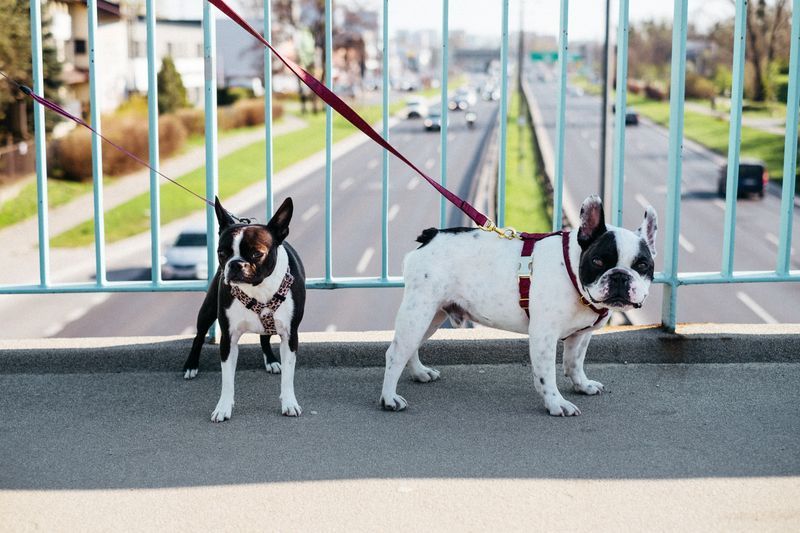
The main differences between a French Bulldog and a Boston Terrier come down to build, ears and energy. Frenchies are shorter, heavier and stockier, with large rounded "bat" ears and a square, wrinkled head. Boston Terriers are taller and leaner, with pointed ears, a rounder head and a signature tuxedo coat. Bostons are usually the more active breed, while Frenchies are more laid back.
French Bulldog Snapshot

- Lifespan: around 10 to 12 years
- Size: about 11 to 13 inches tall, usually under 28 pounds (13 kg)
- Best for: calm homes, apartments and people who are home often
- Notable trait: deeply attached to their people, with a clownish streak
Some Frenchies even grow a softer, longer coat thanks to a recessive gene, and this fluffy French Bulldog breed guide explains how that variation works.
Boston Terrier Snapshot

- Lifespan: around 11 to 13 years
- Size: about 15 to 17 inches tall, up to 25 pounds (11 kg)
- Best for: active families, first-time owners and city living
- Notable trait: gentle and friendly, nicknamed the American Gentleman
That sociable, steady nature is why Bostons turn up so often among dogs that suit busy family homes.
How to Tell a Frenchie and a Boston Apart
Ears and Head Shape
The ears are the quickest giveaway. A Frenchie's ears are large, wide at the base and rounded at the tip, which is where the bat comparison comes from. A Boston's ears are smaller in proportion and finish in a neat point. The head follows suit. Frenchies have a flat-topped, square skull with deep wrinkles above a very short nose, while Bostons have a rounder, smoother head with few folds. Early Bostons were even nicknamed "Round Heads."
Coat Colors and the Tuxedo Pattern
Bostons come in black, brindle or seal, always with white markings, typically a white blaze between the eyes, a white muzzle and a white chest. That symmetrical tuxedo is the breed's calling card. Frenchies come in a wider palette, including brindle, fawn, cream and white, with patchier, less uniform markings. Be wary of "rare" blue or merle Frenchies, which fall outside the breed standard and often signal breeding for looks first.
Body Build and Tail
A Frenchie is compact and heavy-boned, with a broad chest and short legs. A Boston is square and athletic, with longer legs and a lighter frame. Both breeds have naturally short tails, either straight or screw-shaped.
Frenchie and Boston Terrier Size Compared
Bostons are noticeably taller, standing roughly 15 to 17 inches at the shoulder against a Frenchie's 11 to 13 inches. Their weights overlap, though. Boston Terriers are shown in three weight classes (under 15 pounds, 15 to 20 pounds and 20 to 25 pounds), while most adult Frenchies land between 16 and 28 pounds. So the shorter Frenchie is often the heavier dog.
Personality and Temperament of Each Breed
The Frenchie Personality
Frenchies are companion dogs through and through. They are affectionate, comical and happiest on the sofa beside you. They can be stubborn, a little possessive of their favorite person, and some struggle with long stretches alone. Their flat faces and stubby tails also make them easy for other dogs to misread, so this look at whether French Bulldogs are aggressive is worth reading if yours ever grumbles at the park.
The Boston Terrier Temperament
Bostons are bright, bouncy and famously polite with people. They tend to have more get-up-and-go than Frenchies and often love games, tricks and new friends of every species. They are sensitive, so harsh corrections backfire.
Training a Frenchie or a Boston
Both breeds learn best with short, reward-based sessions. Bostons are usually more eager students, while Frenchies want to know what is in it for them. Neither ranks among the canine scholars, but as this honest ranking of the smartest dog breeds points out, obedience is only one kind of intelligence.
Exercise Needs for Two Flat-Faced Breeds
Bostons generally need more activity: two brisk walks a day plus play, and many enjoy beginner agility. Frenchies are content with shorter, gentler walks and indoor games. Skip strenuous exercise in heat or humidity for both. On warm days, sniffing games and puzzle feeders are a safer way to tire them out, and these easy ways to mentally stimulate your dog suit both breeds beautifully.
Choosing a Harness for a Frenchie or Boston
Pressure on the throat is the last thing a short-nosed dog needs, so walk both breeds on a well-fitted harness instead of a collar. Frenchie chests make sizing tricky, and this guide to choosing a dog harness walks through the measurements.
Health Problems in French Bulldogs and Boston Terriers
Both breeds are brachycephalic, so snoring, noisy breathing and heat intolerance come with the territory. In general, Frenchies carry the heavier health burden, with more extreme facial features and a higher risk of spinal disease, skin allergies and airway trouble.
Breathing and Heat Sensitivity
Brachycephalic obstructive airway syndrome, or BOAS, narrows the nostrils and throat and can cause loud breathing, gagging and, in severe cases, collapse. Keep both lean and cool, and ask your vet to check the airway early.
Eyes, Spine and Skin Folds
Bostons have large, prominent eyes that are prone to scratches, corneal ulcers and cataracts, so a quick daily eye check is a good habit. Both breeds can have malformed vertebrae linked to their screw tails, and Frenchies are especially prone to intervertebral disc disease. Frenchie wrinkles trap moisture and need regular cleaning to prevent skin infections. Kneecap problems turn up in both breeds, and Bostons have a higher than average rate of deafness.
Grooming and Shedding in Both Breeds
Both breeds have short, smooth coats that need only a weekly brush, shed lightly to moderately year round, and are not hypoallergenic. The real grooming difference is the face. A Frenchie's folds need wiping and drying a few times a week, while a Boston's main upkeep is keeping those eyes clean.
Cost of a Frenchie Versus a Boston Terrier
Frenchies are usually the more expensive breed to buy, because litters are small and many puppies are delivered by cesarean. Boston Terriers are typically more affordable up front. The bigger expense for either breed comes later, in vet care, so pet insurance taken out early deserves serious thought, especially for a Frenchie.
Finding Healthy Puppies of Either Breed
Whichever breed you choose, a responsible breeder matters far more than color. Ask for health testing on both parents, including airway grading where it is offered, meet the mother, and be wary of anyone advertising extremely flat faces as a selling point. Breed rescues are worth contacting too.
Which Breed Suits Your Home Better?
Choose a French Bulldog if you want a mellow, devoted shadow, live in an apartment, spend plenty of time at home and are ready for higher vet costs. Choose a Boston Terrier if you want a slightly more active, outgoing companion who will happily join longer walks, family games and the occasional \training class.
Before you commit, Cornell's overview of brachycephalic obstructive airway syndrome is a clear, vet-written read on what that short muzzle means for everyday life.
Related Reading


Share a thought, ask a question, or tell us about your own dog. We read every comment.